The Power of a Story, Part II “Mama Kat”

andreacwuerth's avatarFacultyMeeting

The best way to sense the power of a story is to hear the reactions of those who have the privilege of hearing a really good one.

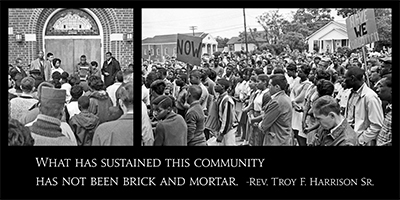
I had the chance to return to Lakewood Middle, this time with Northside resident, Katherine Council, better known as “Mama Kat.” She talked about her experiences in segregated Chapel Hill, as well as during and after the Civil Rights movement, including the story behind this picture of her daughter (on far right) and future son-in-law (far left).

photo 1 Reprinted in Jim Wallace, Courage in the Moment

.

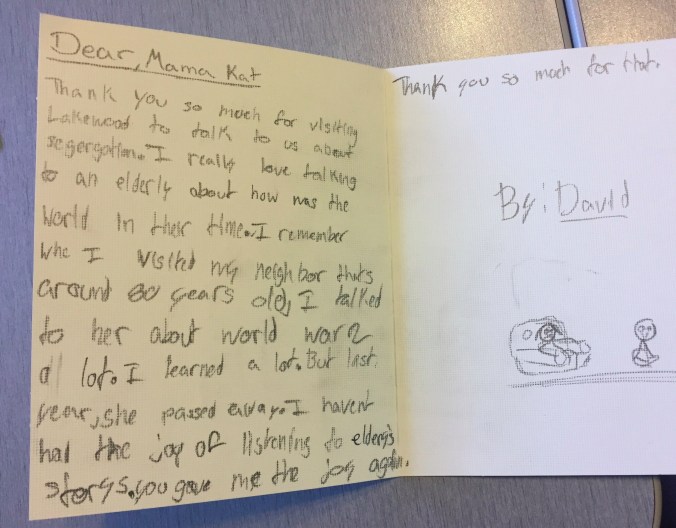
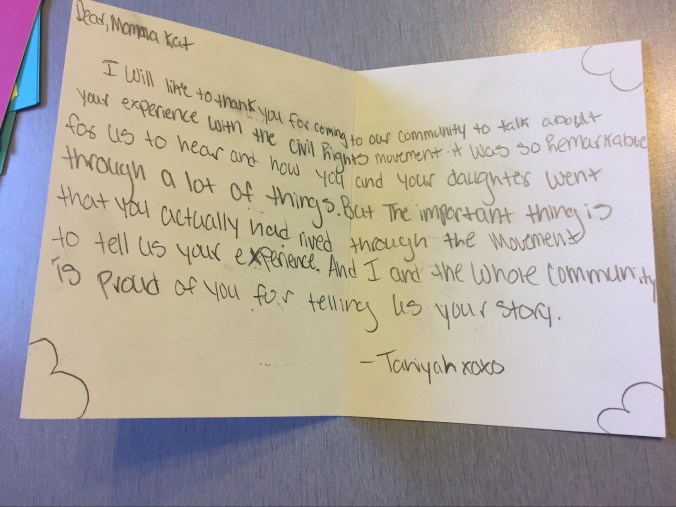
Rather than summarize my impressions of my morning with Mama Kat, I will just let the kids do that, each in his or her own way:

Mama Kat 1Mama Kat 2Mama Kat 3Mama Kat 6Mama Kat 5Mama Kat 4

View original post

The kid at the door

andreacwuerth's avatarFacultyMeeting

When I was in education school, we had to observe teachers in the classroom and write up our observations, like educational anthropologists. I observed a teacher who later became a colleague, a very well-respected veteran teacher. He knew what he was doing– he was enthusiastic about his subject, related warmly to students, engaged students. My notes from eight years ago read:

He is very skillful in making kids feel at ease; relates to students in personal and humorous ways. Also tries to draw out more reticent and ‘nerdy’ kids. Told me he thinks each student is gifted in some way and this seems genuine.

This was an AP history class in one of the highest scoring schools in the state, and I began wondering about equity in a competitive school culture where the playing field is not level. I saw very few kids of color in these classes. And so…

View original post 999 more words

Nasty people needed

andreacwuerth's avatarFacultyMeeting

Recently I attended a groundbreaking ceremony for a new sewage system in the Rogers Road neighborhood of Chapel Hill. This moment was the culmination of decades of struggle and setback that began in 1972 when the neighborhood was promised a number of infrastructural equalizers. Rogers Road seemed to have been overlooked when the towns of Chapel Hill and Carrboro, as well as Orange County claimed and serviced neighborhoods all around this one.

City council members and county commissioners were present at the ceremony, smiling for the cameras as they awkwardly inserted their gold-painted spades into the clay.

Those who led the struggle were acknowledged and held brief speeches thanking other members of the community who supported them. But they stood on the fringes as the groundbreaking proceeded. When I offered one of these men a congratulatory handshake, he said quietly, “I feel uncomfortable at these things.” He may have meant…

View original post 1,091 more words

Aha Moments

andreacwuerth's avatarFacultyMeeting

It was the end of our second interview, and I wanted to ask David Caldwell, Jr., something that would help me summarize the life stories of this remarkable man.

I glanced at my question sheet and asked: “When you look back at your childhood and everything, what do you think was the critical point where you really had your “Aha moment,” saying, “Okay, now I know what I want to do with my life”?

After, graciously, trying to answer the question, David took it down a different path altogether.

DC:  I don’t think I’ve had–. It’s like a cake. Eggs don’t make the cake. The batter doesn’t make the cake. Water, the margarine, the baking powder, it doesn’t –. You have to put it all together. And as you start putting those ingredients together, it’s “Oh, this is a cake! Let’s put some icing on it.” So then you…

View original post 872 more words

Be all you can be

andreacwuerth's avatarFacultyMeeting

Even before they came out with the slogan of the Army, “Be all that you can be” was something that we heard in our community.

Rev. Robert Peter Campbell, July 2017

Mr. Robert Peter Lee Campbell, known to many today as Reverend Campbell but known to those who grew up with him in his Northside neighborhood in Chapel Hill as Peter (or, to some in Northside, “Peter Rabbit”), has lived by these words. On a very hot and humid July day in the community center that resulted largely from his decades-long, unrelenting activism, he talked candidly about his life in Chapel Hill and far beyond:

RC: So I went on to the Job Corps [in 1967] and … I graduated from auto mechanics cluster division and from the food service—what do they call it?—the food service, food handling personnel.

AW: So you did both at the same time.

RC: I…

View original post 1,679 more words

Stumbling on History

andreacwuerth's avatarFacultyMeeting

“The problem, then, is not the stories we tell; it’s the stories we don’t tell.”

Kathryn Schultz in the New Yorker, 22 August 2016

I just finished reading Colson Whitehead’s stunning new novel, Underground Railroad. It was a birthday present, and once I began reading, I couldn’t put it down. It’s fiction, but it is so real. The humanity and the brutality. It’s all there, told through Cora, a slave who takes on a trek north toward freedom in which she experiences and witnesses every horrific act humans are capable of. And for some reason I found myself not turning away or putting the book down. Because I cared what happened to Cora. And because the book was just that good.

Though there have been many powerful movies and books about slavery, I admit that I avoided most. I haven’t seen 50 Years a Slave. I told…

View original post 1,523 more words

A Tale of Two Brothers

andreacwuerth's avatarFacultyMeeting

“The conversations were great and I think that’s where I got my knowing there’s two sides to every story. And I’ve carried that up through my kids and my grandkids.”                      

                                                                                      David Caldwell, Jr., June 9, 2017

Over the course of the last few weeks, I have spent time getting to know a man whose family seems to represent what it has meant to be black in Chapel Hill over time.

David Caldwell, Jr., is, at about six and a half feet, an imposing figure with a warm smile and easy laugh. Since the founding of UNC…

View original post 1,876 more words

Remembering Segregation

andreacwuerth's avatarFacultyMeeting

ShowImage

I’ve often walked from Franklin Street to Rosemary Street, down Roberson or Church or Graham Street and never realized I was crossing a former color line.

There are no obvious markers, just a few remnants of what used to be the Black business district on Rosemary, where the Northside neighborhood begins.

There’s First Baptist church, St. Joseph’s AME and its parsonage (now the Marian Cheek Jackson Center for Saving and Making History). They all were centers of Northside life during the long era of segregation, when these churches, though open to all, were attended only by black residents of Chapel Hill.

When I was teaching at East Chapel Hill High, I was not aware of any classes in which students learned about segregation right here at home. The Jackson Center’s staff has developed numerous educational programs in which Northside residents come to classrooms and tell their stories.

This past week…

View original post 775 more words

Miss Pat’s Town

andreacwuerth's avatarFacultyMeeting

miss pat articleI have lived here all my life. My daughter grew up here. We went to school here. She went to UNC-Chapel Hill. … This is MY town!

                                                                                                                        Ms. Pat Jackson, April 19, 2017

I recently had the privilege of listening to Northside resident Pat Jackson talk about her experience growing up in Chapel Hill– first under segregation, then in the early days of school integration. She credits a community support system for helping her to get through those years; the same community also helped her raise her daughter. That daughter…

View original post 511 more words

Meeting of the Mentors

andreacwuerth's avatarFacultyMeeting

There was Earl and Ronny. Miss Frieda, Miss Lily and Miss Gwen. And the Reverend Williams. All sitting in the front room of the Marion Cheeks Jackson Center. Connected to each other through a shared experience: growing up in the 1950s, 60s and 70s surrounded by a network of unofficial mentors in Chapel Hill’s Northside neighborhood. They were gathered recently on a Tuesday night in August, next door to the church many of them grew up in, because they are mentors to a new generation of kids, growing up in very different times without the benefit of the tight-knit community they knew.

The kids they are mentoring live scattered throughout Chapel Hill, often far beyond the borders of the Northside neighborhood. Kids who know very little if anything at all about the history of Northside or about segregation, civil rights activism, and school desegregation in their own backyards. The mentors…

View original post 991 more words