Whose Story is it?

“This is how I heard the story. . . .” Michael Chabon, Moonglow
 

The Twins and mother?

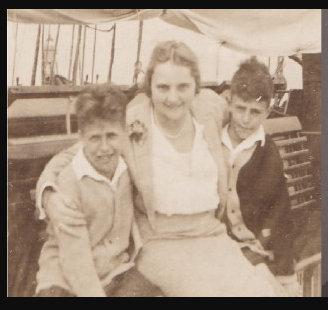
Luke, on right, with his mother and twin brother, Hans, in the early 1930s in Holland

Louis “Luke” Wijnberg, is a resident of a neighborhood in Chapel Hill, North Carolina, that today is known as “Northside.” In close proximity to the university that employed most of its residents, Northside was an all-black neighborhood before desegregation. Over the last fifty years, the neighborhood has seen an influx of new residents and has become more diverse and less affordable. As a volunteer for the Jackson Center for Saving and Making History, I conduct interviews, recording life stories of past and current residents like Luke, who bought his house in 2007.

Luke recently turned 95, so he’s older (but not much older) than some of the other residents I’ve talked with. But unlike the others, he is white.

Before he even agreed to sit down with me, Luke questioned the premise for the interview, suggesting that his reasons for living in the neighborhood had nothing to do with its history. In fact, he didn’t know much about the history of the neighborhood at all and had had little interaction with his neighbors since moving there. As he put it: “I am just one relatively ordinary person who happened to choose 611 Sykes Street as his domicile.”

I persisted, since the director of the Center had passed Luke’s name on to me, mentioning that he knew Luke had a unique and interesting story to tell. For starters, he was a Holocaust survivor.

“Well,” I said. “I want to learn a bit more about your history. You are a Holocaust survivor. Is that right?”

“No. I’m not a survivor. I was never in the camps,” he responded.

The US Holocaust Memorial Museum’s official definition of a survivor includes anyone who was displaced by the policies of the Nazis or their Allies, including refugees like Luke. (www.ushmm.org) Born in Holland, his Jewish parents made arrangements for then sixteen-year-old Luke and his twin brother Hans to emigrate to the United States in 1939. They were adopted by a couple in Brooklyn and heard only after the war ended that their parents, younger brother and many of their close relatives had been rounded up by the Nazis after they occupied Holland, deported to the Westerbork detention camp, and eventually murdered in Auschwitz.

Luke and I continued our introductory conversation for more than an hour. He gave me an overview of some of the major turning points in his life– childhood in Holland, emigration to Brooklyn, matriculation at Brooklyn Polytechnic; enlistment in US Army and return to the European continent as a soldier in WWII; graduate school in engineering physics at Cornell and SUNY; marriage; first jobs in NY state; kids; divorce; second marriage; move to Chapel Hill. By the end of that first meeting, he still was not ready to commit to an interview. He said he’d let me know.

The message I received a few days later was a cc-ed copy of an email addressed to his daughter, Debbie:

I live in the Northside community section of Chapel Hill – traditionally the … enclave for African Americans. UNC has provided some money to establish a kind 0f archive of the residents, old and new, of the Northside neighborhood. One of those residents is me, and Andrea picked on me because I am 94, because I am an immigrant from Europe, because I managed to avoid getting axed in the holocaust (being Jewish), etc. ,because I chose to settle down in late life in the Northside neighborhood. (it was financially doable!) I have not committed myself to provide an interview but am tempted in part in response to Andrea’s obvious interest and dedication.

The next day he confirmed: “I want to go ahead with the interview.”

When I asked him why he conceded, his response was, “If not now, when?” I was, for once, in the right place at the right time.

We began the following Friday– July 25, 2017– and have been meeting more or less weekly ever since. A few times now he’s said in his typical deadpan manner, “We’re going to be doing this until I kick the bucket.”

I am now trying to piece together themes from the stories he’s told me and to begin to reach some understanding of who he is, of the specific circumstances that shaped his life and, in turn, his reactions to and efforts to make sense of those circumstances. My rendering of his life and my understanding of it is incomplete and personal. It is presented here bit by bit, insight by insight. Writing about a life– someone else’s or one’s own– is a process fraught with choices. The writer has someone else’s life in her hands; a series of decisions, some deliberate, some not, transform one person’s stories about their life into the writer’s creation. The stories told are based on what is remembered, fragments, that first the teller, then the writer, piece together into a narrative.

When a life spans more than nine decades as Luke’s does, writing about it feels risky at every turn. Events are recalled that happened long ago. Memory fades though why some are lost and some remain is not clear. And so narratives are incomplete, perhaps random.

Someone who tells the stories is telling how they remember things, and someone who retells the stories is telling not what they heard so much as how they heard them. The fiction that results is what we call “biography” or “autobiography.” And for someone who has been trained to write works that appear on the non-fiction shelves, writing fiction is new terrain.

In the telling of his story, Luke reveals elements that trouble him, raises questions that he cannot answer. It’s as though he is searching for some truth in the telling. — open, reflective, introspective, self-critical. His stories are riveting not only because they contain glimpses into some of the most important developments of the last century, but also because the listener is invited to explores the thoughts and emotions his most vivid memories conjure up. His reflections are lucid and sharp, intellectually rendered but emotionally charged, at times, eccentric, disturbing and humorous. His use of language is very precise and yet appears spontaneous, as though he is thinking out loud; he is a gifted storyteller, who engages the listener not with embellishment and melodrama but straightforward detailed accounts that appear uncensored.

He reflects on his memories as he relates them, engaging the listener’s imagination by his frequent use of phrases like, “I don’t know why I did that,” or “I have no idea why I remember that.” When he then ponders aloud possible explanations, he often brings Freud into the conversation, wondering which subconscious forces might have caused him to focus his attention on certain moments in his life.

What makes talking with Luke such an interactive experience is that he seems to have offered me an open invitation to posit my own spontaneous interpretations, and he takes the time to ponder and react to them. Sometimes he turns the focus on me, asking me to explain my interpretation in greater depth.

The result has been much more than a series of interviews but a relationship between the interviewee–Luke– and the interviewer–me, a friendship that is both intellectual and personal.
 

Party like Olivia

I have written a lot about the Northside community in downtown Chapel Hill and other historically-black neighborhoods in Chapel Hill. And I also have written about the influx of developers who want to turn family homes into student housing.

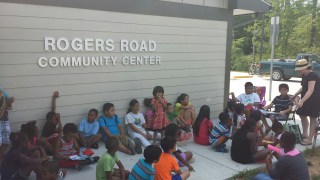
Northside is changing and many “old Northsiders” have embraced the resulting ethnic and socio-economic diversity — including students as well as new immigrants–and have formed alliances with other activists fighting tirelessly to preserve a sense of community. You can see that their hard fought efforts are paying off whenever you step into the Rogers Road or the Hargraves community center at about 3 pm any day of the week.

rena

Every day after school, community activists and volunteers are hard at work and at play with all kinds of kids from the surrounding neighborhoods: African-American, Latino, Burmese (Karen), and white kids are eating delicious snacks prepared for them on-site. They are reading, doing homework, and shooting hoops with college kids and other neighborhood-news-03volunteers; and they are bonding with each other, the way kids do– just by being around each other day in and day out and sensing that they are being treated equally and with respect by the adults in the room.

Many people who lived through segregation will say that they were raised by an entire community– neighbors, teachers, preachers, relatives– and that they were expected to be respectful and play well with others. At the community centers, the same thing is happening today.

The same forces are at work– loving and caring– even if the kids no longer live in the same neighborhood, attend the same church, or go to the same schools, as Northsiders used to. Families aren’t as interdependent, don’t live so close together and don’t depend on each other the way “old” Northsiders did. Something got lost, but thanks to so many activists, there’s still a lot happening every day that is making kids feel a part of something bigger.

Murals at Hargraves Community Center, Northside, Chapel Hill

On a day right before the Thanksgiving holiday,  I asked a spunky third-grader who lives on Craig Street in Northside what she was thankful for. She responded, “I am thankful that I can have a birthday party and invite kids from my neighborhood and that I can play with them whenever I want.” As most parents will tell you, such a thing is rare these days. Parents shuttle kids all over town when they get together for “play dates” and parties.

But Olivia seems to have what Northsiders used to have: enough similar-aged neighborhood kids for a birthday extravaganza. And yet, a party like Olivia’s would never have taken place in Jim Crow Chapel Hill: her party was hosted by her parents, Jason, who is white, and Donna, who is black.

Guests likely reflected the ethnic diversity of today’s Northside.

donna and family

Olivia (in much younger days) with her parents. (Source: donnabell4ch.com)

Community is alive in Northside because its long-time residents largely have accepted change, welcoming new families and students even while resisting and challenging developers and landlords who are indifferent to Northside’s historical importance and community spirit.

greenbridge protest pic

Protest of Greenbridge development   (Source: IndyWeek.com)

And some of the new residents are getting the message and joining seasoned neighborhood activists. They seem to have slowed the tide of disruptive change and succeeded in drawing attention to would be irretrievably lost if market forces aren’t reigned in.

Many current residents are trying to set the terms for the new Northside. Some of those residents have been fighting for years. These days activists’ voices sometimes rise about the din of bulldozers, excavators, and jackhammers, letting the town know that they will not be moved. If, as many here believe, the arc of the university bends toward justice, then history is on their side.

Albert-Williams quote

To join the cause, click here, then contact the Jackson Center. 

Race and class in Carolina

Screen Shot 2017-11-25 at 8.22.01 PM

Source: Wikipedia

His Wikipedia entry gets right to the point: “industrialist, philanthropist, racist.”

How do we make sense of Julian Carr’s legacy today? His financial success and the fame that accompanied it were due to the advantages he had in a racist society that violently subjugated people of color. More accurately stated, he was a racist industrialist and a racist philanthropist; the racism he espoused opened doors for him and closed doors for African-Americans. In the case of his many factories, the doors were closed literally.

Ironically (or maybe not so ironically), one of Carolina’s most liberal towns today bears the name of one of its most outspoken white supremacists.

Due to the influence his money allowed him to buy, he was selected as the keynote speaker at the dedication of the Silent Sam monument which pays tribute to soldiers of the Confederacy and still stands prominently in UNC’s main quad. Leaving no doubt as to the motivation behind the statue’s installation, Carr credited Confederate soldiers with defending the purity of the Anglo-Saxon race in the South, bragging about his own violent enforcement of white superiority. His wealth enabled him to buy the Raleigh News and Observer and thereby to amplify racist viewpoints and silence others.

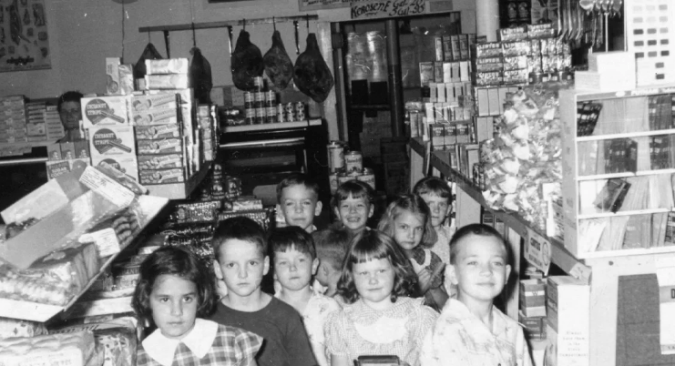
CarrboroPicnic 1950And yet, he also had a reputation as a generous employer. The town, known as Westend, was renamed “Carrboro” after he paid  to have electricity brought to the area in 1909. He opened a textile mill, creating jobs for hundreds of workers and demand for new small businesses. And the events he hosted for his employees and their families earned him a reputation as a magnanimous boss.
 

Screen Shot 2017-11-25 at 9.27.51 PM

Carrboro kids in Cliff’s Meat Market in the 1950s (Source: Chapelboro.com)

Thanks to Mr. Carr, the town appeared to be a Southern small town idyll for the working class. Yet Carr refused to employ African-Americans in the mill. His factory floors were whites-only, and Carrboro became a white-only community.

Paternalistic shows of hospitality were carrots, while a vicious enforcement of anti-union policies were the sticks. Though wages were low, work was stable; such conditions were way beyond the reach of African-Americans who had to choose between sharecropping and working in plantation-like conditions at the University, usually piecing together numerous part-time jobs to make ends meet. University wages were meager; electricity, indoor plumbing and paved roads came to Northside only well into the second  half of the twentieth century.

But not only that. The racist order he and his descendants created by recruiting only white workers for his mill facilitated a local reign of terror against black residents whose neighborhoods were situated along the Carrboro-Chapel Hill border. This order persisted throughout the twentieth century, until the mill officially closed in the 1970s.

1944-chapelhill-negrocommunity

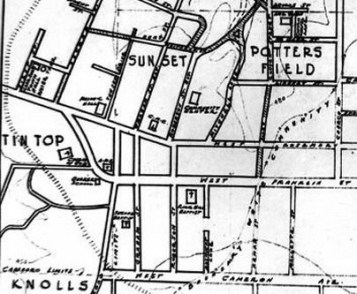
1944 map of African-American neighborhoods in Carrboro and Chapel Hill: Tin Town, Pine Knolls (to the South), as well as Sunset and Pottersfield (together referred to today as “Northside”)

Northsiders have told me that they were acutely aware of the border– Merritt Mill Road– and avoided crossing it. One black neighborhood, a shanty town referred to as “Tin Top” which took its name from the building material used for the roofs, was located on the “wrong” side of the road, dangerously close to Carrboro residences. (Tin Top residences were located in the Kent Court area, on the eastern side of Merritt Mill Road. White neighborhoods, including the Carrboro business district was located along Main Street — see detailed map below)


tin top

Both Carrboro illustrations are taken from: freepages.history.rootsweb.ancestry.com/~orangecountync/places/fcoms/TinTop/TinTop.html

One former Tin Top resident, Don “Hollywood” Riggsbee, remembers occasional skirmishes and sniper-like attacks they launched on white Carrboro residents who threatened them. And a Northsider, David Caldwell, recalled a childhood memory of a brush with a Carrboro Klansman, an encounter which went Caldwell’s way only because the Klansman recognized him as the son of the man who had repaired his car.

As historians often have noted, labor leaders likely may have succeeded in uniting poor working class laborers had industrialists not figured out how to use racism to divide them. Especially in the Reconstructionist South, factory owners like Carr enticed white workers with wages that were higher than those paid to black laborers. The press demonized free blacks and whipped up fear of black crime and violence, not unlike the sorts of press coverage of young black men today. White labor leaders who attempted to cross the color line to organize labor movements (and many did not) ran the risk of becoming victims of white supremacist violence.

Many poor whites in the South bought into the idea that freed slaves posed an economic, political and physical threat to white families; politicians and white power holders of all sorts exploited racist propaganda, not unlike politicians do today.

Gentrification in Carrboro means that it is likely to stay white, just no longer working class. The politics and economy are no longer founded explicitly on racism and exclusion; instead, flags in all colors of the rainbow adorn the lampposts and Carolina’s first openly lesbian mayor inhabits the top office at the town hall. Efforts to create affordable housing are driven by a desire to increase the town’s diversity, a goal the market has placed largely out of reach for low-income and low-wealth families. The goal cannot only be diversity; it has to be social and economic justice.

There is one small but meaningful gesture town leaders can make: honor the call to rename the town. Until the town acknowledges its virulent racist not-too-distant past and stops celebrating the town’s namesake, many Northsiders will always remember the days when they feared for their lives every time they took a short cut to school. How about Cottenboro?

Sources: mastersoftraditionalarts.org; ncmarkers.com

Elizabeth “Libba” Cotten was born in West End, NC (as Carrboro was known then). She was industrious and gave to everyone who would listen. That’s a much more honorable legacy than “industrialist, philanthropist, racist.”