
Source: Wikipedia
His Wikipedia entry gets right to the point: “industrialist, philanthropist, racist.”
How do we make sense of Julian Carr’s legacy today? His financial success and the fame that accompanied it were due to the advantages he had in a racist society that violently subjugated people of color. More accurately stated, he was a racist industrialist and a racist philanthropist; the racism he espoused opened doors for him and closed doors for African-Americans. In the case of his many factories, the doors were closed literally.
Ironically (or maybe not so ironically), one of Carolina’s most liberal towns today bears the name of one of its most outspoken white supremacists.
Due to the influence his money allowed him to buy, he was selected as the keynote speaker at the dedication of the Silent Sam monument which pays tribute to soldiers of the Confederacy and still stands prominently in UNC’s main quad. Leaving no doubt as to the motivation behind the statue’s installation, Carr credited Confederate soldiers with defending the purity of the Anglo-Saxon race in the South, bragging about his own violent enforcement of white superiority. His wealth enabled him to buy the Raleigh News and Observer and thereby to amplify racist viewpoints and silence others.
 And yet, he also had a reputation as a generous employer. The town, known as Westend, was renamed “Carrboro” after he paid to have electricity brought to the area in 1909. He opened a textile mill, creating jobs for hundreds of workers and demand for new small businesses. And the events he hosted for his employees and their families earned him a reputation as a magnanimous boss.
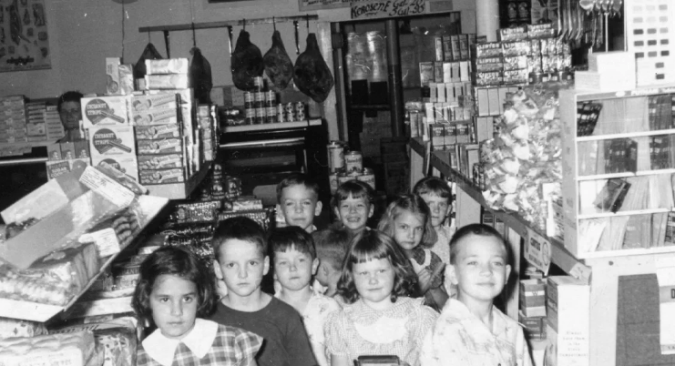
Carrboro kids in Cliff’s Meat Market in the 1950s (Source: Chapelboro.com)
Thanks to Mr. Carr, the town appeared to be a Southern small town idyll for the working class. Yet Carr refused to employ African-Americans in the mill. His factory floors were whites-only, and Carrboro became a white-only community.
Paternalistic shows of hospitality were carrots, while a vicious enforcement of anti-union policies were the sticks. Though wages were low, work was stable; such conditions were way beyond the reach of African-Americans who had to choose between sharecropping and working in plantation-like conditions at the University, usually piecing together numerous part-time jobs to make ends meet. University wages were meager; electricity, indoor plumbing and paved roads came to Northside only well into the second half of the twentieth century.
But not only that. The racist order he and his descendants created by recruiting only white workers for his mill facilitated a local reign of terror against black residents whose neighborhoods were situated along the Carrboro-Chapel Hill border. This order persisted throughout the twentieth century, until the mill officially closed in the 1970s.
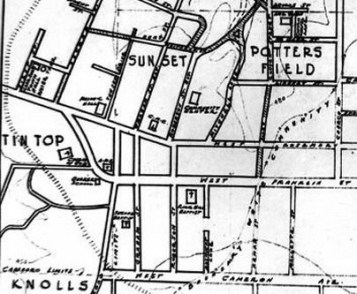
1944 map of African-American neighborhoods in Carrboro and Chapel Hill: Tin Town, Pine Knolls (to the South), as well as Sunset and Pottersfield (together referred to today as “Northside”)
Northsiders have told me that they were acutely aware of the border– Merritt Mill Road– and avoided crossing it. One black neighborhood, a shanty town referred to as “Tin Top” which took its name from the building material used for the roofs, was located on the “wrong” side of the road, dangerously close to Carrboro residences. (Tin Top residences were located in the Kent Court area, on the eastern side of Merritt Mill Road. White neighborhoods, including the Carrboro business district was located along Main Street — see detailed map below)

Both Carrboro illustrations are taken from: freepages.history.rootsweb.ancestry.com/~orangecountync/places/fcoms/TinTop/TinTop.html
One former Tin Top resident, Don “Hollywood” Riggsbee, remembers occasional skirmishes and sniper-like attacks they launched on white Carrboro residents who threatened them. And a Northsider, David Caldwell, recalled a childhood memory of a brush with a Carrboro Klansman, an encounter which went Caldwell’s way only because the Klansman recognized him as the son of the man who had repaired his car.
As historians often have noted, labor leaders likely may have succeeded in uniting poor working class laborers had industrialists not figured out how to use racism to divide them. Especially in the Reconstructionist South, factory owners like Carr enticed white workers with wages that were higher than those paid to black laborers. The press demonized free blacks and whipped up fear of black crime and violence, not unlike the sorts of press coverage of young black men today. White labor leaders who attempted to cross the color line to organize labor movements (and many did not) ran the risk of becoming victims of white supremacist violence.
Many poor whites in the South bought into the idea that freed slaves posed an economic, political and physical threat to white families; politicians and white power holders of all sorts exploited racist propaganda, not unlike politicians do today.
Gentrification in Carrboro means that it is likely to stay white, just no longer working class. The politics and economy are no longer founded explicitly on racism and exclusion; instead, flags in all colors of the rainbow adorn the lampposts and Carolina’s first openly lesbian mayor inhabits the top office at the town hall. Efforts to create affordable housing are driven by a desire to increase the town’s diversity, a goal the market has placed largely out of reach for low-income and low-wealth families. The goal cannot only be diversity; it has to be social and economic justice.
There is one small but meaningful gesture town leaders can make: honor the call to rename the town. Until the town acknowledges its virulent racist not-too-distant past and stops celebrating the town’s namesake, many Northsiders will always remember the days when they feared for their lives every time they took a short cut to school. How about Cottenboro?


Sources: mastersoftraditionalarts.org; ncmarkers.com
Elizabeth “Libba” Cotten was born in West End, NC (as Carrboro was known then). She was industrious and gave to everyone who would listen. That’s a much more honorable legacy than “industrialist, philanthropist, racist.”
 Chapel Hill Stories