Bringing up the neighborhood

Screen Shot 2018-02-23 at 8.42.40 AM.png

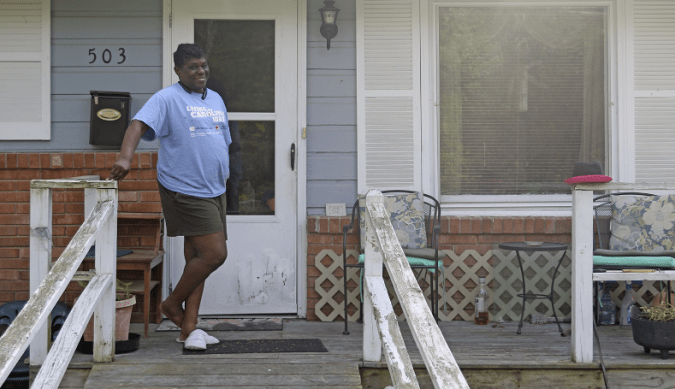
Meet Cleo Caldwell. If you’ve ever walked by her house you probably already have.

A fifty-something new grandma, she grew up on 503 Chapel Street in Chapel Hill’s Northside neighborhood, moved away, and came back to a different sort of place. When she was growing up, white people did not live on her street or on any of the surrounding blocks; Jim Crow determined where you lived and where you didn’t.

Now her neighbors are mostly students. And in her warm and exhuberant way, she embraces the change. She told a reporter from the Daily Tarheel recently:

Whenever they move in, I always introduce myself because this is my home, I grew up here and I know the whole neighborhood. (4/13/2017)

She says that with pride and generosity. Her neighborhood is open to all, though she is very clear about her expectations of neighborliness. As a teacher, I know that it’s essential to raise expectations for all students. Miss Cleo, as most people call her, raises expectations for all neighbors. It’s a formula for continuity and responsibility. In the name of community values like those that the Northside neighborhood was known for when she was coming up, she sets and publicizes the ground rules. She carries with her the institutional memory and the spirit of the place she grew up in.

In more recent times, she’s had to tell drug buyers and sellers down the street that they should take their business elsewhere. And since she remembers some of them from her childhood, she tells them, why don’t they just take it to their mamas and grandma’s street? Cleo reminds them that someone is always watching, someone who knows their mamas.

I felt instantly at home in Cleo’s living room. And so, I’m just going to give it to you straight the way Cleo gave it to me. Notice the italics I’ve put for emphasis. I think it’s interesting to ponder Cleo’s definition of ownership. She isn’t talking legal or financial. She gets at what it means to take ownership of your life and to make a real connection to your place in the world and to the people around you:

Cleo (CC): What I see when I sit on my porch—I do like to drink my Moscato—I sit on the porch and the students–

Me (AW): Moscato. I’m writing that down! [laughs]

CC: And the students will pass by and I, you know, some of them will pass by and I’m like, “Excuse me, I’m Miss Caldwell. You can speak to me when you see me on the porch.” They’re like, “Miss Cleo!” I even had the– girl, I’ve got it in that cabinet right there. They gave me a wine glass.

AW: [Laughs] You’ve got a reputation.

CC: You see that grill out there?

AW: Yeah.

CC: I’ll fire it up anytime. They’ll be like, “Oh, Miss Cleo, that smells good.” I’ll be like, “Come on over here. If y’all want something to eat, y’all come on over.” That’s just me. But I always tell them, when I’m sitting on my porch, everything that I can see I own. [emphasis mine]

AW: Oh my god. Well, you know what? That’s the nicest thing though for a lot of kids because a lot of college kids have no connection to real life.

CC: And I tell them, “Take care of the house that you live in, because somebody else used to live in that house.” [emphasis mine]

AW: That’s a beautiful thing. You’re a one-woman gospel.

CC: And I tell them, “You know, it’s okay for y’all to have y’all parties. I was once in college. It’s okay to have your parties. But guess what? Clean that yard up when y’all get finished.”

AW: Oh, yeah.

CC: I don’t have any problems. Especially like here.

AW: Do you ever have to talk to them?

CC: Uh-uh.

AW: You serious?

CC: Nope. None.

AW: That’s amazing.

CC: They go, “Miss Cleo, Can we park in your driveway, da, da, da.?” “Yup.”

AW: You never had any problems with any students?

CC: Uh-uh.

AW: Oh, that’s really—That’s amazing to hear.

CC: Nope. Because, like I said, I put my foot down on day one. What happens is the guys who live over there, they’re like, “Oh, yeah— “ I went over to introduce myself. “Oh, yeah, we know about you, Miss Cleo.”

AW: [laughs]

CC: So, they’re passing my name down. And I tell them, “When y’all go out of town, I have their cell numbers. If somebody’s going to be there, let me know, if everybody’s going to be gone. Because if something’s not right, I’m calling 911. I had to call 911 for that tan house. I’m sitting here—me and my friend are sitting here, and I’m like, Wait a minute. It’s Christmas. Everybody’s gone. So I sat and I watched them. I’m looking out the window and I just said –[makes a tapping gesture as though she’s pressing buttons on a phone]. I said, “This is Cleo Caldwell at 503 Chapel Street. There’s a guy over there in that yard over there on McDade. He don’t live there. The students are gone.” They came. And I even went out on the porch because I’m like, you know, a lot of people would be afraid because they might think the guy might retaliate or something. They had been looking for that guy, that same guy–

AW: Are you serious?

CC: had been breaking into houses. They had been looking for him. But they could not hold him because they did not catch him in the house. He didn’t break in. But he was looking for a way in. He would have went through and ransacked, took everything from those students.

AW: And you told those kids?

CC: And you know what I tell them, “We work too hard for the stuff that we have for them to come in and take it just like that.”

AW: Yeah, yeah.

CC: So I’m always watching. I’m like the neighborhood watch. If I hear sirens, if I see lights, I’m going to where that’s at. I want to know what’s going on.

AW: Yeah.

CC: Cause this is my neighborhood. [emphasis mine]

AW: I love to hear that.

CC: I own this neighborhood. [laughs]

AW: Oh, you do. And I love the way, I love what you’re doing with the kids because, you know, it makes them —even though they would not take the initiative usually—it makes them feel connected. You’re doing them a favor.

CC: Absolutely. And they know, in a couple years everybody’s going to be gone. But so-and-so and so-and-so is going to be there. Okay, because one guy came back early and I saw a light on. So before I called the police, I called the cell phone to make sure, “Hey, okay, I see a light on. Did somebody come—?“ “Oh, yeah, Miss Cleo. We’re sorry. So-and-so, so he came back early.” I said, “Okay, because I was getting ready to call the police.” I was on top of it. Oh, yes, ma’am. I watch.

AW: It’s not always like that. In some neighborhoods, there are kids doing things they shouldn’t do. There are disrespectful kids. They’re loud. They’re peeing on people’s lawns.

CC: Not in my neighborhood.

CC: Like I tell them, you know, I try to be involved. I try to preserve.[emphasis mine] … Habitat [for Humanity] was really, really good because I got into that program and everything. 

AW: You deserve everything that this neighborhood has to offer you.

        CC: I’m just trying to keep what I can.


The next day, I stopped by with a bottle of Moscato.

Her front door was open.


Pauli’s Legacy

UNC’s liberalism would soon be put to the test.  (www.paulimurrayproject.org)


In 1938, President Franklin Delano Roosevelt visited Chapel Hill, North Carolina, as he had done on a number of prior occasions, to accept an honorary degree. When he accepted the award, he called the University of North Carolina “a great institution of learning that was thinking and acting in terms of today and tomorrow and not merely in the tradition of yesterday,” and declared:

I am happy and proud to become an alumnus of the University of North Carolina, typifying as it does American liberal thought through American action.

But what FDR did not say was that this “liberal” university, like all Southern universities, did not admit African-American students even if they met the other admission criteria. When African-Americans wanted to attend college in the South, their only option was to matriculate at a “Negro” college, today referred to as HBCs (Historically Black Colleges).

If a Black student sought to study medicine or law or another subject not offered at “Negro” colleges in North Carolina, the state met its legal obligation to provide all children with access to education by giving them the option to attend a university “up North,” in this way upholding the strict separation of Black and White under Jim Crow.

Not all North Carolinians accepted this arrangement. In fact, just a few months before FDR received his honorary degree in Chapel Hill, a young, Black woman from Durham challenged UNC’s racist order by applying for admission to the law school. Emboldened by a keen intellect and a proud family tradition in education, Pauli Murray pursued the matter by going straight to the top.

A remarkable new book entitled, The Firebrand and First Lady describes the relationship between Murray and Eleanor Roosevelt that began when Pauli wrote to her husband, the President, furious that he had not taken a firm stand against lynching and white supremacy. She wrote:

It is the task of enlightened individuals to bring the torch of education to those who are not enlightened. There is a crying need for education among my own people. No on realizes this more than I do. But the un-Christian, un-American conditions in the South make it impossible for me and other young Negroes to live there and continue our faith in the ideals of democracy and Christianity.(as cited in Bell Scott, 27)

Then, alluding to the looming crisis beginning to consume FDR’s political agenda, she added: “We are as much political refugees from the South as any of the Jews in Germany.”

Finally, she challenged him by quoting directly from his acceptance speak at UNC:

You called on Americans to support a liberal philosophy based on democracy. What does this mean for Negro Americans? … Does it mean, that as an alumnus of the University of North Carolina, you are ready to use your prestige and influence to see to it that this step is taken toward greater opportunity for mutual understanding of race relations in the South? (as cited in Bell Scott, 28)

Murray included a letter for Mrs. Roosevelt, making reference to a brief encounter between the two women a few years earlier, imploring her to “try to understand the spirit and deep perplexity in which it is written.”

With this letter, the friendship between Murray and Eleanor Roosevelt began; it  intensified through correspondence and meetings over many years until Roosevelt’s death in 1962.

Murray was never accepted at UNC, despite personal petitions to President Frank Porter Graham, a personal friend of the Roosevelt’s, who seemed to sympathize with her pleas but felt it would not be politically expedient to honor them.

gwendolyn harrison smith

Gwendolyn Harrison Smith- first black woman to be admitted to a graduate program in 1951. The university first admitted her as it did other women on a case-by-case basis, not realizing she was African-American, then attempted to revoke her admission when their error was discovered. Harrison Smith, who had earned a BA at Spelman College and the and a master’s degree at the University of California, fought UNC’s policy and won, but left before finishing her degree. (Source: blackmattersus.com)

Murray went “up North,” graduating at the top of her class at Howard Law School. There, she met a man who became instrumental in desegregating UNC and later became the first Black Supreme Court Justice, Thurgood Marshall. Murray wanted to continue her education and applied for a fellowship at Harvard Law School. Interestingly, Murray was rejected by Harvard despite impeccable credentials, not because she was Black but because she was a woman. Murray spent her life fighting on both fronts.

frasiers and brandon

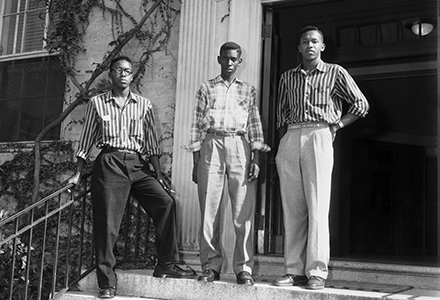
Ralph Frasier, John Brandon and LeRoy Frasier, Jr., on the UNC campus in 1955 (Source: unc.edu)

It wasn’t until the landmark 1954 Supreme Court Brown v. Board of Education decision that legal challenges to racist admission policies met with success. After a series of law suits, UNC was forced to accept black undergraduates for the first time in 1955. Three graduates of Hillside High in Durham– John Brandon, Ralph Frasier and LeRoy Frasier, Jr.– started together amidst vocal opposition by the Board of Trustees, as well as many administrators, faculty members and students. This antagonism was one of the main reasons all three of UNC’s first black undergrads left Carolina and graduated from other universities.

Pauli’s legacy, as well as Gwendolyn’s, Ralph’s, John’s and LeRoy’s and those of so many other pioneers, lies in questioning what liberalism has meant for the cause of racial and social justice. Though we often assume, wrongly, that the two are connected, they aren’t, neither in theory nor in practice.

In theory, liberalism offers freedom from restrictions and limitations, legal or otherwise. Liberalism is much closer to what we know as libertarianism, rather than social progressivism. Progressives rely on government and other mechanisms of power to level the playing field, to equalize opportunity, even if this means coercing resisters. Historically, liberals often have defended the idea of equal opportunity and fair competition, including equal access to education.

And yet it seems that in our university town, many liberals seem more concerned with securing resources for their children than creating a level playing field. I wonder if this is the case in other college towns that pride themselves on their good public schools. Among white educated families in Chapel Hill, the unlevel playing field is tolerated or ignored in the face of blatant inequality.

For centuries, liberal elites tolerated racial and gender-based barriers that denied education to a majority of US citizens. Despite demands made by social movements and activists, those with power to change things have accepted exorbitant higher education costs, even though these clearly limit access to the country’s best universities to all but a very small upper-middle class and wealthy minority.

Here in the state of North Carolina, tuition for state universities are often too costly and application requirements too complicated for many potential first-gen applicants. Even the community college system charges more than many kids can afford. And those who get in, often don’t make it through. Is enough being done?

If Chapel Hill is any indication, liberals do no better at creating conditions for educational success of African-Americans than elites in other towns do; in fact, the opportunity gap in town hasn’t changed much since segregation ended. And local elites aren’t really fooling anyone.

Screen Shot 2018-02-20 at 12.21.38 PM

Source: Raleigh News and Observer (October 30, 2015)

Pauli knew it; and she called UNC on it. Today her voice would most likely join the chorus of those teachers and parents who still regularly challenge town elites. Like Pauli and Gwendolyn and Ralph and John and LeRoy, local activists today speak their truths, then work with anyone who is willing to meet with them. So many local activists have simply not given up despite disappointment after disappointment. I’ve met many of them and the story is pretty much always the same. As one local minister said to me yesterday, “Politics are heavy in this town.”

And somehow enough people have been audacious enough to keep pushing for change.


For more on Pauli Murray, click here.

Lee way

Screen Shot 2018-02-20 at 12.00.43 PM.pngMany locals will tell people proudly that Chapel Hill, North Carolina, was the first majority-white town in the South to elect a Black mayor. The year was 1969. Though many told him it was too soon after desegregation and the town wasn’t ready, Howard Lee launched a campaign anyway. He used a strategy much like the one Barack Obama used to win the Presidency a few decades later: grassroots community organizing of the most thorough sort.

Lee and his wife had moved to Chapel Hill in 1964; he got a master’s degree at UNC, and then began teaching at Duke and North Carolina Central. Their story tells a lot about the climate at the time. As he told WUNC interviewer Frank Stasio:

I had tried to buy a house in Chapel Hill and no realtor would sell me a house. We finally ended up buying a house by working with a white family, by tricking the realtor.

I have heard a lot of stories like this one, about black people with audacity and individual white people with audacity who helped chip away at segregation. There are the stories of the legendary Dean Smith who entered segregated eating establishments with his Black players and requested a table. And a couple I know who did the same with their Black friends. And the students who demonstrated, sat in front of segregated stores, and engaged in various acts of civil disobedience for which some were arrested.

And yet the fact remains:  in the mid-1960s, after businesses had officially desegregated, black university professors were denied housing outside of neighborhoods historically designated as “black.” The Lees and their two children received death threats, and the Klan burned a cross on their front lawn. Lee twice went to the city asking the Council to pass an open housing ordinance. City officials refused. Swim clubs, university facilities, golf clubs– all were still segregated in the mid-1960s. As Lee puts it:

There were some nasty, nasty events in Chapel Hill during the civil rights era.

Though this observation may come as a surprise to some given Chapel Hill’s reputation as a liberal haven in the racist South, the Lees probably expected the town wouldn’t live up to the hype. Howard grew up in Georgia, joined the Army and served in Korea where he “tasted freedom.” As he told Stasio:

When you taste freedom and then you lose it again, that’s a tough pill to swallow. So when I came back from Korea and settled in as a probation officer in Savannah, Georgia, I found myself right back in the oppressive, discriminatory environment where I was paid a hundred dollars less than my white counterparts in the juvenile justice system.

What defined Lee’s fight for equality was his commitment to not racialize the issue directly, but to work within the system, using his position to advocate and act on behalf of those the system cheated. Another part of the “Lee Way” was to recognize the various forms oppression can take; in his experience, poor and working class white kids in Savannah also suffered disadvantages. Speaking of Savannah, Lee recalled:

We lived next door to whites. We got along well. … But the difference was during that day was white families thought they were better than black families and didn’t accept that they were being treated just as poorly. Today it’s even worse.

Lee saw the parallels when he moved to Chapel Hill where he recognized the plight of most of the white kids in mostly working class, or as many saw it, “redneck” Carrboro.

And yet it was in the Black neighborhoods that city street paving, maintenance, sewer and water stopped.

When he decided to run for mayor, he found himself opposed by a progressive democrat. But Lee wanted to make sure desegregation progressed and put it at the top of his agenda. At the time, only one-fifth of one percent of public officials in the US was black.

Lee was, I think, enticed by the challenge and had a vision for how African-Americans and other disenfranchised groups could challenge systemic injustices and gain power within the system:

We organized Chapel Hill like it had never been organized before by using students from the university and faculty and also brining students in from around the state using somewhat of a civil rights tactic of getting people to come from the outside to help us on the inside.

For Lee, his campaign wasn’t about race. It was about fairness and empowerment. And it was about educating African-Americans about the power they could wield in a democracy when they were organized and informed. One of the local activists, Edwin Caldwell, whose family members had been at the forefront of the local civil rights movement, gives a moving and powerful account of the way the Lee campaign worked “on the ground” on election day:

We would say, ‘Look, who are you going to vote for?’ “Well you know I’m going to let the Lord.” I said, “No, we ain’t going to let the Lord choose today. You take this piece of paper, this is who you vote for. You let the lord choose some other day.” So we pretty much told them who to vote for. We controlled things. They went in there and they came out and people were proud. You talking about South Africa and voting, people were voting in Chapel Hill and they were proud the same way. You could just see their backs straighten up and see how proud they were. I worked the streets until the polls closed, we got every vote that we could find. We almost wrestled some people in that didn’t want to go, but once they went and voted they were proud.

So there is a strong commitment to democracy and justice in this liberal town. But it’s just not among those folks who most often take credit for it. Howard Lee’s election is more a story of what it took for Blacks to overcome the many obstacles to equality here than a story of white liberal progressivism.


Teaching in Black and White

 Chapel Hill High then and now…

But I just told him, your generation’s dying, dad. We’ll take over from you and we’ll do it our way now.    Bettie F.


On one of the many unseasonably warm days this December, I had the chance to talk with a friend in the Carol Woods Retirement Community in Chapel Hill. Bettie is white, a soft-spoken eighty-something with a warm, welcoming demeanor. As we sat sipping tea in her living room, surrounded by walls and shelves full of mementos from the rich intellectual life of a traveler and educator, she spoke freely and modestly about her life journey. She is the sort of person who appears worldly and cosmopolitan, so that it is a bit surprising when she starts by revealing her deep roots in the rural South. Like many Southerners I’ve met, Bettie speaks honestly and directly about race:

My dad was from South Carolina, and he was very learned. But he was chemically a racist. But he was a gentleman. And if the maid was black and she picked up your sugar cube and put it in your cup like that, he didn’t blink. He just was perfectly happy with that because he was used to being around black people. And because you are civilized you speak well and you do not feel– . Anyway, and mom was a Christian. “Everyone is God’s child,” and all that jazz. And she just loved little pickaninnies. [laughs] Anyway, but she is genuine, and she tried to integrate her church.

Something about the way she tells the story, consciously including unflattering details without sentimentality makes it easy to ask for more. And Bettie graciously continued:

Dad had a rage, I think, about what happened to South Carolina. He was born in 1883; he’s much older than my mom. And his feeling was– he was born twenty years after his grandfather was killed at Chicamaugua, and that was the one who owned the farm and the plantation and so forth. And his other grandfather was killed, his father’s grandfather, and they lost the slaves, they lost the land, and the house was destroyed by Sherman’s raiders. Not Sherman, but the kind of riff-raff that went along with losing and all that. And he always talked about Reconstruction in South Carolina.  But I came in absolutely with my mother’s ideas that everybody was deserving of an education; everybody should have good health; everybody should have respect and all the rest of it.

Bettie studied history, then traveled around the world to teach in private schools. She met her husband while teaching in Beirut, and they returned to the US when he was offered a university position. They had two children, moved around and ended up in Chapel Hill in 1964, just after the local civil rights movement had succeeded in pressuring local businesses to desegregate. School desegregation was underway but did not officially happen until 1967.

When I asked her what she thought of the reluctance of UNC and the Chapel Hill school board to desegregate as soon as it was ordered by the Supreme Court in 1954, she expressed disappointment with the leaders now usually credited with their progressive liberalism:

… it’s hard to accept that people like Frank Porter Graham [President of UNC from 1930-1949 ] also didn’t want to push it. They wanted it, but, I don’t know. My mother used to kick me under the table when I was mouthing off about things, because I couldn’t see any reason why you shouldn’t get together. [laughs] Couldn’t quite understand the deepness of the divide.

Bettie taught first at a private Quaker school, the first interracial school in the Chapel Hill area, before taking a job at Chapel Hill High School in the early 1970s. In the first years after desegregation, there were some tensions, culminating in a stand-off between some student protestors who opposed the way in which the white leadership often denigrated or overlooked black students, faculty, and traditions from the old Lincoln High school. What did Bettie notice when she arrived? How did she see the situation?

AW:            Did you feel like the administration of the history department was trying to get people to —Black and White—to get along with each other? You know, was there any dialogue about the race—just addressing the elephant in the room sometimes about race issues?

BF:            Oh no. Now granted I was hired right at the last minute after–. But no, I’m just friendly, so I got along.

AW:             But there was trust among the teachers then? There wasn’t any—

BF:            I don’t know what to say about that. I didn’t think the problem was the teachers, although I’m sure there were thoughts on the black teachers’ side on how privileged the white teachers were. I just didn’t hear it.

Bettie explains many of the issues in the school in black and white terms. A few former CHHS students told me that discussions of race had taken place in some classrooms. One teacher whose name came up a few times was the chairperson of the history department who taught the first classes in African American history. Mrs. Joyce Clayton would address racism in class and encourage students to challenge people to think about how to get along with each other.


Bettie is almost apologetic when she says she was primarily concerned that students learn the subject material and that students “should know things.” Her classroom was for learning about history and sociology, but that didn’t mean that learning didn’t get personal. In fact, Bettie took some bold steps to address race in her sociology classes:

I had a soc[iology] class and I was bringing a husband, who was black, and his wife, who was white, to talk about an interracial marriage. We were studying marriage at the time. And Pat was a very handsome, intellectual, competent leader in the community and one of the students got on her chair and yelled at him and yelled at him. I said, “You’ve got to leave the room.” So I finally got her out of the room and down the hall, yelling. I didn’t know what was wrong. And it turned out, she was a leader in the making of the Black community and here was a Black guy who wastes himself on a White woman. [laughs] I just had no idea. But he understood it very well.

Despite the tension apparent in the situation, in her humble and straightforward rendering I imagine students felt empowered to speak their minds on the issues of the day when they were in her classroom. Few teachers today would be as bold and passionate as to arrange for very personal discussions about race the way that she did. In fact, by encouraging students to discuss their own views and experiences in the classroom, Bettie clearly found ways to make sociology meaningful and relevant. I’m certain most students did not forget this lesson, though I wonder how they processed the discussion and what the different take-aways were.

Bettie’s own children had African-American friends and her daughter had a number of Black boyfriends.

…the one thing I thought that was good that was worked out was the Chapel Hill Preschool that was started at the Community Church in the sixties … and they matched the kids —one black to one white. And those kids knew each other all the way through school. And it didn’t work perfectly but they were used to each other. 

She is quick to add this is not to suggest she or her children somehow are free of racial bias. When she recounts those experiences, she still thinks she could have done more, learned more, to build a better understanding of race and make more connections to members of the Black community.

She enthusiastically reported on a forum she’d been to at her retirement community. Two women, one black and one white, talked about the book they had written together about attending Hillside High School in Durham at the time it was being desegregated. (For a link to the book by Cindy Geary and LaHoma Romicki, Going to School in Black and White, click here.) Unlike Chapel Hill High, white students were bussed to all-black schools, as well as the other way around. At Hillside in the 1970s, white students and faculty were in the minority.

The people in that book, both people white and black, had lots to learn about the other. I don’t know. I did not do that. I was just trying to teach history. I thought that was over with. I didn’t realize – maybe– since it was not by any means over with.

Perhaps the fact that desegregation was a one-way street, where Black students and teachers were always made to feel they had to catch up, that they were “lesser,” explains why integration has failed in Chapel Hill. Students are still separate, opportunities are anything but equal. The past defines the present.

Bettie challenges every one, no matter how committed to equality we say we are, no matter how smart we think we are, no matter how educated,  no matter how far we think attitudes toward race have evolved, to begin by changing our attitude:

I’ve been awakened to stop being so smug. These issues are deep within us and going on still.