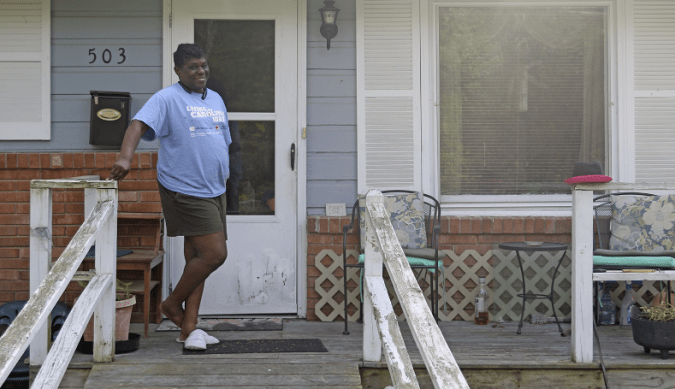
Meet Cleo Caldwell. If you’ve ever walked by her house you probably already have.
A fifty-something new grandma, she grew up on 503 Chapel Street in Chapel Hill’s Northside neighborhood, moved away, and came back to a different sort of place. When she was growing up, white people did not live on her street or on any of the surrounding blocks; Jim Crow determined where you lived and where you didn’t.
Now her neighbors are mostly students. And in her warm and exhuberant way, she embraces the change. She told a reporter from the Daily Tarheel recently:
Whenever they move in, I always introduce myself because this is my home, I grew up here and I know the whole neighborhood. (4/13/2017)
She says that with pride and generosity. Her neighborhood is open to all, though she is very clear about her expectations of neighborliness. As a teacher, I know that it’s essential to raise expectations for all students. Miss Cleo, as most people call her, raises expectations for all neighbors. It’s a formula for continuity and responsibility. In the name of community values like those that the Northside neighborhood was known for when she was coming up, she sets and publicizes the ground rules. She carries with her the institutional memory and the spirit of the place she grew up in.
In more recent times, she’s had to tell drug buyers and sellers down the street that they should take their business elsewhere. And since she remembers some of them from her childhood, she tells them, why don’t they just take it to their mamas and grandma’s street? Cleo reminds them that someone is always watching, someone who knows their mamas.
I felt instantly at home in Cleo’s living room. And so, I’m just going to give it to you straight the way Cleo gave it to me. Notice the italics I’ve put for emphasis. I think it’s interesting to ponder Cleo’s definition of ownership. She isn’t talking legal or financial. She gets at what it means to take ownership of your life and to make a real connection to your place in the world and to the people around you:
Cleo (CC): What I see when I sit on my porch—I do like to drink my Moscato—I sit on the porch and the students–
Me (AW): Moscato. I’m writing that down! [laughs]
CC: And the students will pass by and I, you know, some of them will pass by and I’m like, “Excuse me, I’m Miss Caldwell. You can speak to me when you see me on the porch.” They’re like, “Miss Cleo!” I even had the– girl, I’ve got it in that cabinet right there. They gave me a wine glass.
AW: [Laughs] You’ve got a reputation.
CC: You see that grill out there?
AW: Yeah.
CC: I’ll fire it up anytime. They’ll be like, “Oh, Miss Cleo, that smells good.” I’ll be like, “Come on over here. If y’all want something to eat, y’all come on over.” That’s just me. But I always tell them, when I’m sitting on my porch, everything that I can see I own. [emphasis mine]
AW: Oh my god. Well, you know what? That’s the nicest thing though for a lot of kids because a lot of college kids have no connection to real life.
CC: And I tell them, “Take care of the house that you live in, because somebody else used to live in that house.” [emphasis mine]
AW: That’s a beautiful thing. You’re a one-woman gospel.
CC: And I tell them, “You know, it’s okay for y’all to have y’all parties. I was once in college. It’s okay to have your parties. But guess what? Clean that yard up when y’all get finished.”
AW: Oh, yeah.
CC: I don’t have any problems. Especially like here.
AW: Do you ever have to talk to them?
CC: Uh-uh.
AW: You serious?
CC: Nope. None.
AW: That’s amazing.
CC: They go, “Miss Cleo, Can we park in your driveway, da, da, da.?” “Yup.”
AW: You never had any problems with any students?
CC: Uh-uh.
AW: Oh, that’s really—That’s amazing to hear.
CC: Nope. Because, like I said, I put my foot down on day one. What happens is the guys who live over there, they’re like, “Oh, yeah— “ I went over to introduce myself. “Oh, yeah, we know about you, Miss Cleo.”
AW: [laughs]
CC: So, they’re passing my name down. And I tell them, “When y’all go out of town, I have their cell numbers. If somebody’s going to be there, let me know, if everybody’s going to be gone. Because if something’s not right, I’m calling 911. I had to call 911 for that tan house. I’m sitting here—me and my friend are sitting here, and I’m like, Wait a minute. It’s Christmas. Everybody’s gone. So I sat and I watched them. I’m looking out the window and I just said –[makes a tapping gesture as though she’s pressing buttons on a phone]. I said, “This is Cleo Caldwell at 503 Chapel Street. There’s a guy over there in that yard over there on McDade. He don’t live there. The students are gone.” They came. And I even went out on the porch because I’m like, you know, a lot of people would be afraid because they might think the guy might retaliate or something. They had been looking for that guy, that same guy–
AW: Are you serious?
CC: had been breaking into houses. They had been looking for him. But they could not hold him because they did not catch him in the house. He didn’t break in. But he was looking for a way in. He would have went through and ransacked, took everything from those students.
AW: And you told those kids?
CC: And you know what I tell them, “We work too hard for the stuff that we have for them to come in and take it just like that.”
AW: Yeah, yeah.
CC: So I’m always watching. I’m like the neighborhood watch. If I hear sirens, if I see lights, I’m going to where that’s at. I want to know what’s going on.
AW: Yeah.
CC: Cause this is my neighborhood. [emphasis mine]
AW: I love to hear that.
CC: I own this neighborhood. [laughs]
AW: Oh, you do. And I love the way, I love what you’re doing with the kids because, you know, it makes them —even though they would not take the initiative usually—it makes them feel connected. You’re doing them a favor.
CC: Absolutely. And they know, in a couple years everybody’s going to be gone. But so-and-so and so-and-so is going to be there. Okay, because one guy came back early and I saw a light on. So before I called the police, I called the cell phone to make sure, “Hey, okay, I see a light on. Did somebody come—?“ “Oh, yeah, Miss Cleo. We’re sorry. So-and-so, so he came back early.” I said, “Okay, because I was getting ready to call the police.” I was on top of it. Oh, yes, ma’am. I watch.
AW: It’s not always like that. In some neighborhoods, there are kids doing things they shouldn’t do. There are disrespectful kids. They’re loud. They’re peeing on people’s lawns.
CC: Not in my neighborhood.
…
CC: Like I tell them, you know, I try to be involved. I try to preserve.[emphasis mine] … Habitat [for Humanity] was really, really good because I got into that program and everything.
…
AW: You deserve everything that this neighborhood has to offer you.
CC: I’m just trying to keep what I can.
The next day, I stopped by with a bottle of Moscato.
Her front door was open.
 Chapel Hill Stories