Honoring All Veterans


Screen Shot 2018-11-11 at 8.34.36 PM
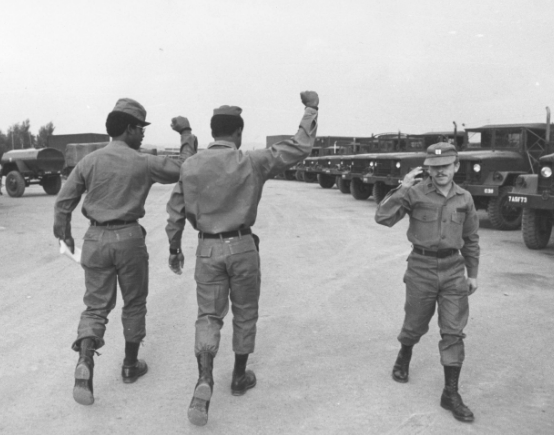
The platoon was segregated. And on that island of Bougainville, after things got quieted down over there, we ran into some white companies, and we socialized together. And after we took the island, they brought us beer and stuff up there then, and we’d get together and just drink beer together. But as far as being together fighting, the blacks were in their part and the whites in their part.

Joseph Fearrington, Resident of Northside

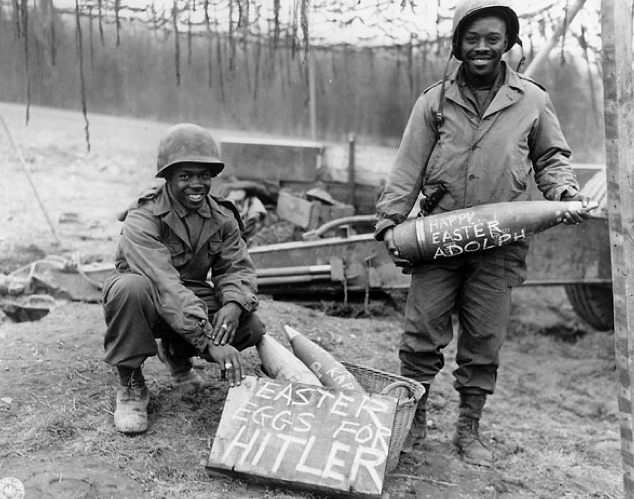
Northside, Pine Knolls, Tin Top and Rogers Road are home to many veterans– including a few, like Joseph Fearrington, who served in a segregated army. The history of African Americans in the armed forces is not much different than the history of African Americans in a deeply racist America. African-Americans served a country that relegated them to second-class citizenship; the armed forces willingly accepted them, and yet their service didn’t make a difference when they returned to the segregated South.

At no time was the injustice more clear than after World War II. Having helped defeat Hitler and liberate the Nazi concentration camps, African Americans were at the center of a heroic chapter of history, part of what has been called the “greatest generation,” and yet are virtually unrecognized as such.

Deeply embroiled in an ideological war against Communism, the US depicted itself as the leader of the free world, even as Jim Crow kept African Americans from exercising basic rights enjoyed by white US citizens, an irony that did not go unnoticed by Communist governments eager to point out US hypocrisy. And it didn’t go unnoticed by African American soldiers from the southern US, many of whom experienced their first “breaths of freedom” while serving in the military.

As many returning soldiers from the South saw it, they faced more danger at home than they had in Europe: “It was much more difficult functioning in the US than it was in Europe. You know you could run and hide from rockets coming out of Aachen, Germany. But you couldn’t run and hide from the kind of verbal abuse you got in Alabama, Georgia, Mississippi.” An editorial in the Chicago Defender in 1950 asked, “Why is it that a Negro soldier can face death alongside a white soldier in the heat of battle but still can’t sit alongside him and fraternize when the war is over?”

Screen Shot 2018-11-12 at 12.21.38 PM

For some, especially those who had a white partner, staying in Europe was a better option than returning to the South. According to one US Air Force veteran: “‘We were treated better by the civilian population than we were treated in America. See, in our country we could not buy a hotdog when we were in uniform, had to ride in the back of the bus when we were in uniform. … That is why a lot of blacks took their discharge in Europe. They said, look, ain’t nothing in America for me.’”

Once it moved into the global spotlight, the glaring injustices in the military led to official desegregation in 1947. Nevertheless, as soldiers’ testimonies suggest, actual integration and equality came very slowly.

Historian Maria Hoehn has written books about African-American GIs in Germany and discovered a connection between experience in the military and participation in the Civil Rights movement. In fact, many Civil Rights leaders had been stationed in Europe and concluded that the sorts of freedoms every soldier enjoyed had to be possible in the land of the free as well. William Gardner Smith, author of Return to Black America, wrote, “So you know what it’s like for a Negro to be among the ‘conquerors’ instead of the defeated? We learned about it for the first time when we ‘occupied’ Germany and none of us ever got over it. We’ll never go back to the old way again. … We were equal, in fact more equal, than the Germans.”

Not only did this realization lend a spark to the civil rights movement back home, but black GIs also became increasingly politicized within the armed forces. A 1970 Defense Department report on the state of race relations in the military in Europe noted that the movements wrenching apart the country at home were also leading to rifts on military bases. Race relations, it said, were the Army’s biggest concern abroad. Integration meant the end of official segregation but did not end racism and abuse among servicemen and women.

So, this Veteran’s Day, when you thank an African-American vet for his or her service, you can thank them for standing tall in the face of racism inside and outside the military. And often you can also thank them for helping bring the fight against racism home and helping to bend the moral arc of the universe toward peace and justice.
Screen Shot 2018-11-12 at 12.17.06 PM

For information on how to watch a Smithsonian documentary, “Breath of Freedom,” produced by Maria Hoehn, see: https://www.smithsonianchannel.com/shows/breath-of-freedom/0/3402153.

To listen to Joseph Fearrington’s oral history, go to: https://archives.jacksoncenter.info/items/show/382.
 

The platoon was segregated. And on that island of Bougainville, after things got quieted down over there, we ran into some white companies, and we socialized together. And after we took the island, they brought us beer and stuff up there then, and we’d get together and just drink beer together. But as far as being together fighting, the blacks were in their part and the whites in their part. Joseph Fearrington


Northside, Pine Knolls, Tin Top and Rogers Road are home to many veterans– including a few, like Joseph Fearrington, who served in a segregated army. The history of African Americans in the armed forces is not much different than the history of African Americans in a deeply racist America. African-Americans served a country that relegated them to second-class citizenship; the armed forces willingly accepted them, and yet their service didn’t make a difference when they returned to the segregated South.

At no time was the injustice more clear than after World War II. Having helped defeat Hitler and liberate the Nazi concentration camps, African Americans were at the center of a heroic chapter of history, part of what has been called the “greatest generation,” and yet are virtually unrecognized as such.


Deeply embroiled in an ideological war against Communism, the US depicted itself as the leader of the free world, even as Jim Crow kept African Americans from exercising basic rights enjoyed by white US citizens, an irony that did not go unnoticed by Communist governments eager to point out US hypocrisy. And it didn’t go unnoticed by African American soldiers from the southern US, many of whom experienced their first “breaths of freedom” while serving in the military.

As many returning soldiers from the South saw it, they faced more danger at home than they had in Europe: “It was much more difficult functioning in the US than it was in Europe. You know you could run and hide from rockets coming out of Aachen, Germany. But you couldn’t run and hide from the kind of verbal abuse you got in Alabama, Georgia, Mississippi.” An editorial in the Chicago Defender in 1950 asked, “Why is it that a Negro soldier can face death alongside a white soldier in the heat of battle but still can’t sit alongside him and fraternize when the war is over?”


For some, especially those who had a white partner, staying in Europe was a better option than returning to the South. According to one US Air Force veteran: “‘We were treated better by the civilian population than we were treated in America. See, in our country we could not buy a hotdog when we were in uniform, had to ride in the back of the bus when we were in uniform. … That is why a lot of blacks took their discharge in Europe. They said, look, ain’t nothing in America for me.’”

Once it moved into the global spotlight, the glaring injustices in the military led to official desegregation in 1947. Nevertheless, as soldiers’ testimonies suggest, actual integration and equality came very slowly.

Historian Maria Hoehn has written books about African-American GIs in Germany and discovered a connection between experience in the military and participation in the Civil Rights movement. In fact, many Civil Rights leaders had been stationed in Europe and concluded that the sorts of freedoms every soldier enjoyed had to be possible in the land of the free as well. William Gardner Smith, author of Return to Black America, wrote, “So you know what it’s like for a Negro to be among the ‘conquerors’ instead of the defeated? We learned about it for the first time when we ‘occupied’ Germany and none of us ever got over it. We’ll never go back to the old way again. … We were equal, in fact more equal, than the Germans.”

Not only did this realization lend a spark to the civil rights movement back home, but black GIs also became increasingly politicized within the armed forces. A 1970 Defense Department report on the state of race relations in the military in Europe noted that the movements wrenching apart the country at home were also leading to rifts on military bases. Race relations, it said, were the Army’s biggest concern abroad. Integration meant the end of official segregation but did not end racism and abuse among servicemen and women.

So, this Veteran’s Day, when you thank an African-American vet for his or her service, you can thank them for standing tall in the face of racism inside and outside the military. And often you can also thank them for helping bring the fight against racism home and helping to bend the moral arc of the universe toward peace and justice.


For information on how to watch a Smithsonian documentary, “Breath of Freedom,” produced by Maria Hoehn, see: https://www.smithsonianchannel.com/shows/breath-of-freedom/0/3402153.

To listen to Joseph Fearrington’s oral history, go to: https://archives.jacksoncenter.info/items/show/382.

Coming out, crossing over


[It was] Like, ‘Della, it’s not going to work for you to just stay so private. You’re going to have to put your whole self into this. … That’s just the call of this work. You’re going to have to come out.’   

UNC Professor Della Pollock in an interview, 8 October 2016


The story of how the Jackson Center for Saving and Making History in the Northside neighborhood in Chapel Hill came to be is best told by those who made the first moves to fix a broken relationship between the university and its African American neighbors. Recognizing the neighborhood’s historical importance and cultural value, a team consisting of university professor and a group of students began an effort to conduct oral interviews with Northside residents in 2007. When they first approached residents, a lot of history got in the way. Their efforts proved more challenging and more rewarding than they imagined. Right at the onset they discovered that historically unequal relationships have to be redefined before they can be fixed.

The following stories describe white people’s efforts to cross over into the black community. Some wanted to record people’s stories; one, a developer, just wanted approval, to hear that he was a good guy and to get a thumbs-up for decisions he already had made.

Luckily, UNC Professor Della Pollock figured out that building a good relationship meant listening very closely in a most vulnerable way and letting the words she heard really sink in. She was able to discover that African Americans’ place on the margins– literally and figuratively– of the university and its privileged campus community represents a critical vantage point, one that is founded upon notions of justice and equality and grounded in the history of struggle. Della’s story about her encounter with Ed Caldwell suggests that listeners must be prepared to leave their comfort zones, to relinquish a place of privilege:

Of course we were really shiny, bright academics and really committed to good and good liberals and we really believed– I’m making this a really gross caricature–that giving people the opportunity to tell their stories was giving them a big gift. So we talked with Ed Caldwell, at the time the head of the alumni association for the former black high school, Lincoln High, which we’ll hear more about– and we recently had an interaction with the head of that alumni association that was equally challenging, or similarly challenging. And Ed just said, and what I still experience as a slap upside the head, “Y’all have studied the hell out of the black community. Why should I help you?”And it took me about ten years to understand that by “y’all “he didn’t just mean me personally, but he meant the university. And I was the stand-in for the university. And “studying the hell out of the place” was just a nightmarish image, just [eviscerating] it and contributing to its disintegration, its disrepair, and creating a kind of hell for the people living in it. And then I learned right there one of the most defining lessons that I have ever learned, which was that I didn’t have any power whatsoever and that it’s an illusion that a lot of our academics hold that we should be so chagrined by our power and that we need to share it and distribute it. When Ed said to me, “Why should I help you?” he had the power. And he knew his neighborhood. He was the watchdog for his neighborhood. And I needed his help for my little project, as it were, the way he flipped it.

… [W]hat we managed to do was to conclude it at least with a major public event. And we used in that setting the model of performance that we will be experimenting with here next week which is a very low level of retelling what you hear in the first person and some of the students were working with– well, one of the students was working with–an interview she had conducted with an uncle who was the brother to a grand wizard for the Ku Klux Klan; somebody else was working with her mom, who she didn’t know was one of the first people to integrate her elementary school. And at the closing of this full day of presentations and conversations Ed stood up, and he was just weeping and just swinging his arm out kind of trying to embrace all the students and saying, “Y’all are missionaries. Y’all are missionaries.”And of course, I had been sweating bullets and I was just relieved mostly. But that gave me an opportunity to think about what that “y’all” was about, and how he had renamed and reclaimed and offered us a place in the community of faith especially of which he saw himself a critical part. And this work at least carried the seed of a paradigm of work and a kind of responsibility that could, if continually practiced with sustained effort over many, many years, begin to answer the question, “Why should I help you?”


Hudson Vaughan, at the time a UNC student activist, who grew up in a multiracial, low-income neighborhood in Memphis, describes a similar sort of calling out by the woman who ended up becoming the history center’s namesake, Marian Cheek Jackson:

So then my senior year, in the fall of my senior year, they said, I had a friend come up and was like, “I’m in a class. I’m probably going to have to drop it. But you should take it because it’s got your name written all over it.” And I was like, “Why?” And they were like, “It’s got the black church, desegregation, oral history, like it’s a combination of all these things that you love. And you love asking people questions, so you should take Della’s class.”… And we chose, we got to choose kind of, she had a list of folks we could potentially interview and we started to go to church on Sunday as well, but we chose Mrs. Jackson because she was the church historian. We were really interested in learning about the church history, and I was more fascinated because I, “There are actually churches here! Why didn’t I know this.” And so we showed up at Knotts funeral home– because she didn’t want us to come to her house– where she worked, which at that time looked out over the field where Greenbridge is now, and the first time we ever went in, Mrs. Jackson—we called her and called and called to set up a time—and so we finally went in and Mrs. Jackson said that she needed to go make a copy and didn’t come out for an hour. So we just sat there and she was fumbling papers in the back just really trying to avoid us. And she came back in and she was not interested in an oral history interview, and so we just decided we’d start hanging out. So we started hanging out and at one point she was writing the church history like a week later and she asked us if we could help type it up and we were like, “Sure.” So we typed up the church history and in that process she was making corrections so we started to learn church history. And then she started to share history and then we started to work, she started to point out and talk about the black community and how it used to stretch from McDonald’s down to the KFC is what she’d say. She’d say, “The commercial interests are pushing us out, and it’s not about us. It’s about them. But they keep saying it’s about us. They keep wanting to think, acting like all these buildings are for us. But you don’t see any of us in there. And she was saying, And people are losing our sense of history.” And that’s when we first heard that motto, “Without the past, there is no future.” It was like, young people aren’t learning the incredible history. This town doesn’t know the history of the people who have laid the bricks and built the buildings. And she started talking about her grandfather coming as a former slave and building the stone walls around the university, and her father starting the janitorial association, and the work that she had done at NC Mutual which was part of the black Wall Street in Durham. …

            And then my connection back is that we at the end of that semester, we had spent all of this time with Mrs. Jackson and just gotten to know her as somebody—I mean, if people meet her, she’s got this most incredible spirit you know this beautiful laugh and she tells amazing stories and she has the deepest faith and just this sense of why faith is so important to the struggle which connected with my history as somebody who’d come out of this faith tradition that was really about a faith that goes out and is less about the evangelical component and more about what does it really mean to be part of a ( ) community.


Both of these first encounters — between Della and Ed Caldwell and between Hudson and Marian Jackson– happened on terms that the Northsiders established, since they were the ones being asked to give something: their time, and, first and foremost, their stories. Normally, it’s unsettling to be asked to share your story with a virtual stranger. Add to that the loaded history of past encounters between representatives of UNC and Northsiders, between blacks and whites who historically have specified the terms of cross-racial interactions in minute detail in order to reinforce a power hierarchy and remind blacks of their “place,” and suddenly their effort to define the terms becomes a powerful act of resistance.

By changing the terms, by altering the usual discourse in which their subservience is assumed beneath a veneer of Southern politeness, both Mr. Caldwell and Mrs. Jackson sent messages that, fortunately, Della and Hudson were ready to hear. That’s what made them so different and that’s, ultimately, what made the Jackson Center possible. It would not have come about without the establishment of relationships of mutual regard and trust. And those relationships had to take place on terms set by the community. It helped that Mrs. Jackson’s terms were also defined by her commitment to reconciliation and love.

As Della describes it, the work with Northside involved “becoming close and vulnerable,” “being called forward.” Community on the “other” side may demand checking privilege and ego before crossing. And not many have been willing to do this.

The next story shows a more typical example of how members of the black community have been and, for the most part, how they continue to be approached. At the time Della was exploring her oral history project, a few developers had gotten permission to build a mixed-use luxury building in downtown Chapel Hill right in the middle of the former black business district, a building that would cast a shadow both literally and metaphorically over the mostly black residential neighborhood adjacent to it. By the mid-2000s, the Northside neighborhood was feeling consistent pressure from aggressive realtors and rising rents, and the university was doing nothing to preserve and protect its long-term residents.

When construction vehicles blocked the entrance to the popular black funeral home next door, neighbors, together with students, organized to challenge the project and were rebuffed. Community leaders called for a series of meetings, and invited the developers, who had been adamantly insisting they had the community’s best interests in mind. Hudson and Della recall it like this:

HV: And the steering committee was all of these African American pastors especially and he [developer Tim Toben] came in to this meeting … and the first thing he does is open up his laptop, and say, “I want to show you a video.” And he shows us this video–I think it was made for the Obama campaign. And it was saying community means, “Come into unity.”… So he like then went on a lecture like we need to understand what real community means. …So Reverend Royster then stands up and literally is like, “I cannot believe you would accuse our integrity. This is one of the things that all of us hold dear to ourselves and you have no right to claim this and you need to publicly apologize,” basically.


DP: And at that point he storms out—


HV: Slams the keyboard. And just walks out. Bolts.


DP: So instead of participating in any way in an ongoing dialogue—


HV: Walks out of the room.


As Della and Hudson tell their story to the Jackson Center staff on a Friday afternoon in 2016, one person in the room, a Jackson Center Board member, just listens. His name is Michael Campbell, a black man with lots of experience in local government and in dealing with the issues between Duke University and the Durham neighborhood surrounding it. On the recording, we hear him say he has to leave to go to another meeting. When Hudson asks Michael if he has any parting questions, Michael comments: “What this work exposes is that you got to get to know the people, the folks who are living the issue, that’s where the education is. And work up from that and see how do we come together to resource and address the issues that people live; in a way, that you get with them and with people you’ll understand those issues. And so it’s slower work, but it’s much more rewarding work. It’s much more progressive.”

It seems to me, not only is it more progressive but for Della, Hudson and the dozens and dozens of students, community activists, and other UNC folks who have crossed over the divide, it’s been both life-changing and life-affirming.


Pictures of a movement

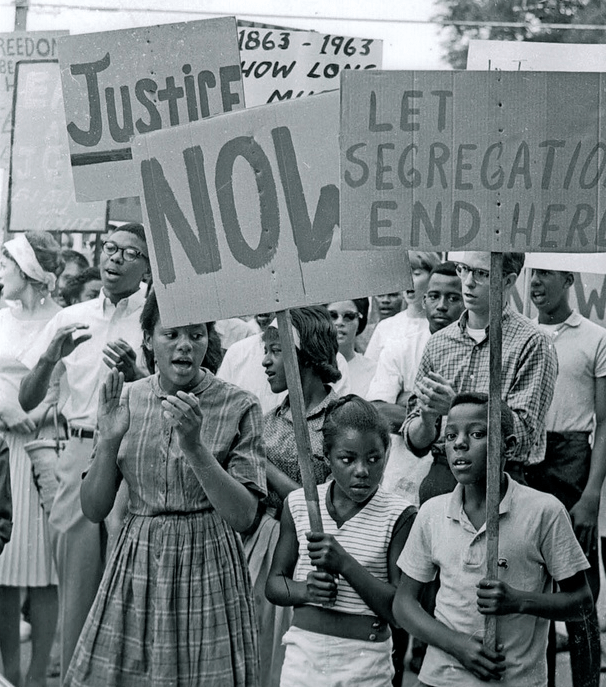
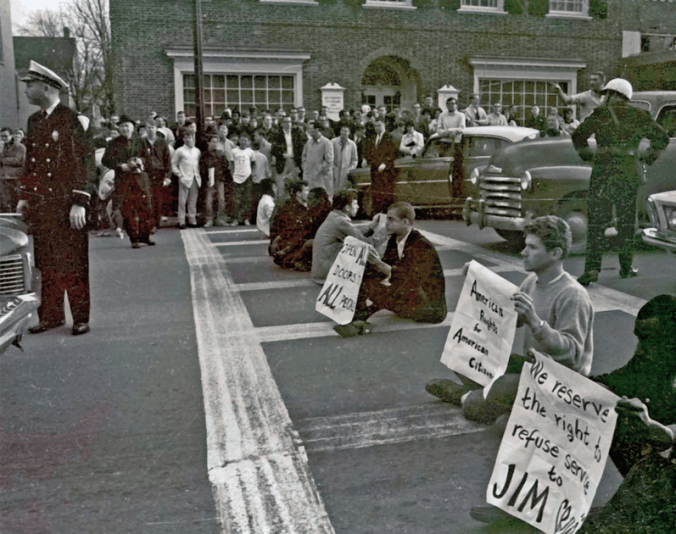
These photos are from Jim Wallace, Courage in the Moment, and the quotes that follow each photo are from interviews recently recorded with local movement participants, residents of the Northside and Pine Knolls neighborhoods in Chapel Hill. Photos and interviews can found on the Marian Cheek Jackson Center website in the Oral History Archive.

Screen Shot 2018-08-04 at 10.47.08 PM

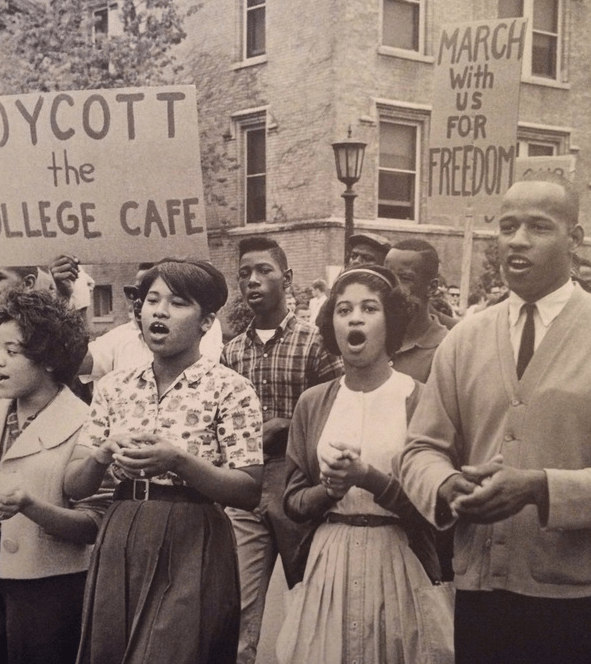
Carol Purefoy Brooks (second from the right): “I think basically in Chapel Hill we had a wonderful march. … Chapel Hill wasn’t as violent. … It just seemed like you were enjoying yourself and having a wonderful time, getting to know new people. … We were cheerleaders at Lincoln High School and they asked if we wanted to lead a march. And we said, ‘Yes, we did.’ We all grew up here and we all knew each other even though he [Harold Foster, one of the movement leaders] was older. We all got along well.”


Screen Shot 2018-08-04 at 10.45.52 PM

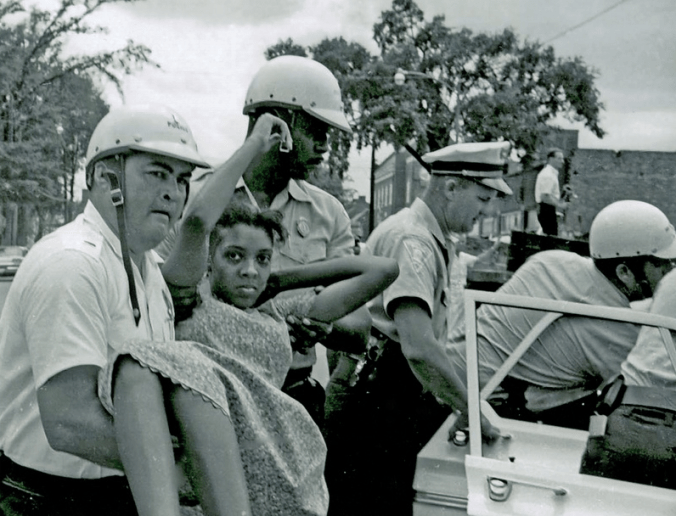
Euyvonne Cotton (looking straight at the camera): “I had on a dress. When they first picked me up they had me by here and here. I didn’t know who picked me up, but I know it was a young white cop in front of me. … And it was funny, because he was trying to shake me to shake my dress down so they could see up underneath that dress. I vaguely remember getting into that car. I remember getting locked up, all of us in that cell, you know. But I was not mistreated by them. … I was fifteen. And they didn’t know I was fifteen at the time. And when they realized how old I was, they said, ‘You have to go.’ …I got involved because my uncle, James Brittain, was involved. This was his life.”


foushee_photo_2.jpg  

James Foushee (top left, man on far right, participating in Easter Week hunger strike, March, 1964): “Our whole objective was to wear the cops out.”


Screen Shot 2018-08-04 at 10.38.33 PM


Linda Brown: “I can remember my mother sending us down and telling us that she wanted us to participate—the children. They wanted the children to participate because they could not do it because of their job. So that’s why we went out there instead of our parents marching. So that’s how my family got involved.”

Keith Edwards: “In ’61, I was eleven and Linda was ten. We were just marching. Whenever somebody told us to march, we’d march.”


Screen Shot 2018-08-04 at 10.54.45 PM

Keith Edwards (speaking to a gathering of Chapel Hill civil rights movement veterans): “Well there was one time, you all were sitting in the streets… and what happened, some people were coming up, motorists. There were some white motorists. And they would put their car in park. But they would rev the motor up. You know, they would just smash on the gas. And that would really scare me, that the car was going to jump out of gear and, you know, run over you all. Because it would have killed you because the cars were right on up and you could read the bumper. And that was scary for me to even watch. But you all stood your ground. You did not move.”

William Carter: “We were ready to jump up at in a heartbeat, just in case.” [laughter]


Screen Shot 2018-08-04 at 10.50.12 PM

Clementine Self (woman holding flag): “Well, I was very involved. I did all of the marches. I did the sit-ins but I didn’t allow myself to get arrested, because my dad worked at that time at the Carolina Inn and he thought that if I got arrested he might lose his job.”

Hudson Vaughan: “That’s probably true.”

CS: “Probably true. So I’d do that and do the sit-in, but when the police got to me I’d stand up and move back, and other people would get arrested, but that’s the only reason why I didn’t. But I did all the marches, the sit-ins, the whole nine yards. But they felt, they didn’t have any problem with me doing it.”


(Find these photos and more in the oral history archive at: jacksoncenter.info)


Minding your own business

…you saw those people being in your community, and then as you continued to get a little older, you would see these people as entrepreneurs —how fascinating, you know, to just be able to see the same common people that you would see all of the time as business people too.

Pat Jackson, 2011

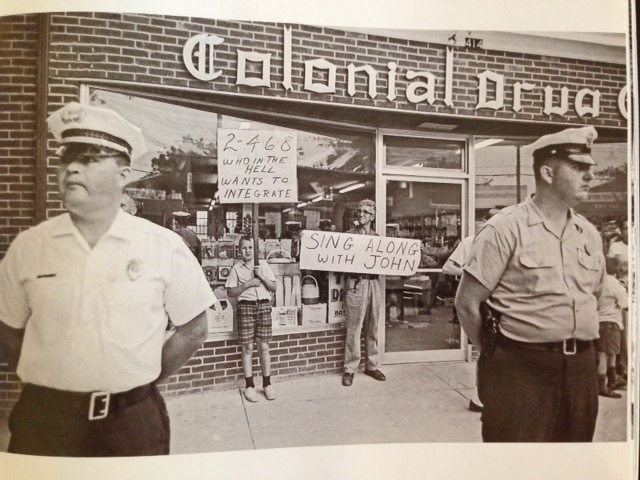
If you’re familiar with Jim Wallace’s photos of the civil rights movement in Chapel Hill (many of which have been featured on this blog), you can see what it took to get many white merchants in downtown Chapel Hill to desegregate their stores. Pictures show students and residents picketing restaurants like the Pines, Brady’s, and the Dairy Bar on Franklin; sitting at lunch counters where they were taunted and refused service; carrying signs, marching and pointing their fingers at businesses like Colonial Drug and Joe’s; enduring verbal and physical attacks; and being arrested by the local cops.

Other white-owned businesses served black customers but generally did not make them feel welcome. Northsiders tell story after story about having to enter businesses from back entrances and waiting for service after all white customers were served first. Less often remembered are the many businesses in town that not only served black people; they welcomed them with open arms. And today, there are few traces of them in downtown Chapel Hill.

2468

Northside resident Chelsea Alston remembers how things used to be: “I’ve heard stories from people that were around when there were Black owned businesses and most people that owned those businesses were family members or they knew the kid’s parents. It was really easy for them to come in and just hang around and don’t have to worry about safety or anything. Or parents being worried about where they were at because they knew the person that owned the place so they knew they would be fine, their children would be fine. So if there were more Black owned businesses there would be more places for African Americans to go and hang out.”

Black owned businesses were mostly what we call “micro-enterprises” today; they emerged from very few resources since Chapel Hill banks did not lend to blacks. They emerged out of the need for goods and services including ambulance and basic medical services, since black residents were underserved and in many cases not served at all. And businesses arose out of the need for income since many of the jobs available to black residents were very poorly paid. Most families needed multiple sources of income to make ends meet.

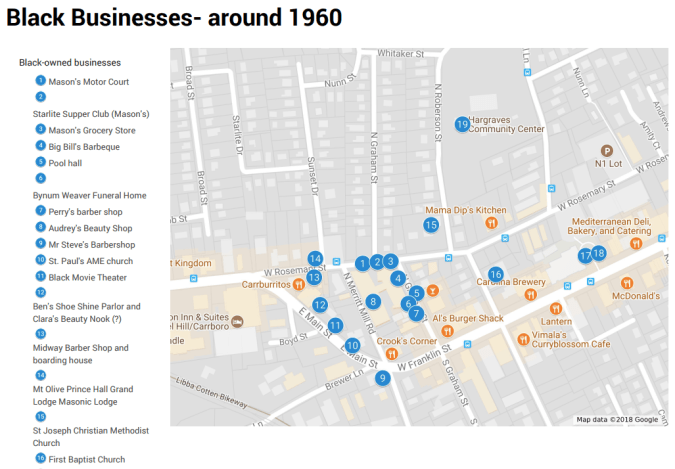
The area bordering the Northside neighborhood, especially a few blocks on West Rosemary and North Graham Streets, was known as Chapel Hill’s black business district. Northsiders could shop for groceries there, get a haircut, buy some barbeque, listen to music. Black travelers who were refused a room at Watt’s Motel and everywhere else in Chapel Hill could check in to Mason’s or one of the boarding houses in Northside and get a good night’s sleep. While they couldn’t get a table at the Pines, Northsiders could get front-row seats at Charlie Mason’s Starlite Supper Club and listen to world-renowned musicians including Ike and Tina Turner, James Brown, and Ella Fitzgerald. If you were an expert bricklayer, wanted to do good for your community, there happened to be a Prince Hall Grand Lodge Masonic Temple that recognized black stone masons, right on the Carrboro-Chapel Hill border on West Rosemary. You called Bynum Weaver’s if you needed an ambulance or had to arrange a funeral; or you could go to Weaver’s market and get some candy while your mama had her hair done by Miss Susie Weaver in her beauty shop. And nobody minded—in fact, it seems it was expected– that you lingered a bit and caught up on local gossip or asked about family members.

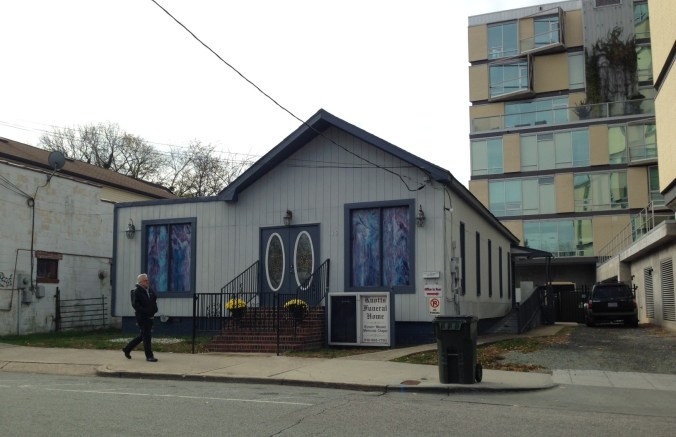
Today, only 3.6 percent of local businesses in Chapel Hill are Black owned, and towering over the center of what once was known as the Midway District is Greenbridge, a six-story building of luxury condominiums, a fitness studio and a start-up company that cater to a more affluent set. In the words of Willis Farrington, who grew up a few blocks away: “This thing has taken up probably about six or seven either homes or … Black owned businesses where this mass of building now stands.” Bynum Weaver’s is still there; now it’s called Knotts Funeral Home, but it looks pretty much like it did. It’s still black-run and Black owned, and there’s still enough local demand for a family-run place that knows its customers.

And of course there’s Mama Dip’s, run by Mildred Council since 1976, a time when many of the black businesses she grew up with were going out of business. Many locals today point to Mama Dip as an example of a thriving Black owned business, but Mama Dip and many Northsiders remember a time when dozens of Black owned businesses lined the streets and local residents frequented a place called Bill’s Barbeque. As Mr. Farrington tells it: “Before they even thought of this Greenbridge, used to be Bill’s Barbeque. And Bill’s Barbeque was where Mama Dip pretty much, from what we – those that know her and know him—got her start, from their little restaurant used to sit right here. And had the best chicken sandwiches and chuck wagon sandwiches and hot dogs in town.”

In addition to the official storefront businesses, Chapel Hill’s black neighborhoods were home to a vibrant and essential informal economy. The neighbors knew where to go if you needed a ride, hauling, medical services, a boarding house, a good meal, laundry services, child care, auto work, household repairs, sewing work, masonry, medical attention, a floral arrangement or some fresh produce. Joe Farrington used to grow vegetables on his backyard plot; when the corn and the sweet potatoes were ripe, he recalls, neighbors were invited to come and get some.

Like pretty much anywhere else in the world, an informal economy emerged in Chapel Hill because the entrance to the formal economy was blocked by segregation and the many manifestations of racism from depressed wages to lack of financial services to the threat of violence. The cost of doing business with white people – even if not officially prohibited — was often much too high. Clementine Self grew up on Graham Street and participated in many of the civil rights demonstrations in the early sixties when she was in high school.

She and her mother, Lucy Farrington, describe the scene in downtown Chapel Hill to interviewer Hudson Vaughan:

Lucy Farrington: And I remember when the man at the drugstore wouldn’t let me have no sandwich. I got into a whole lot.

Clementine Self: That was Colonial Drug.

Hudson Vaughan: They took the booths out too, didn’t they?

CS: Yeah, they took the booths out so that we couldn’t sit down. So they decided no one would sit. Everybody would have to stand or leave. And Brady’s, which is, what is it? 501 now, I think it’s called. It’s right in front of Trader Joe’s.

HV: Yeah, yeah. Okay. Right in front of Trader Joe’s. CS: But on the street.

HV: Like towards Route 15/501?

CS: Yeah, it faces 15/501 when you come down, like if you’re coming down 15/501, there’s a restaurant sitting over there to the right?

HV: Okay.

CS: That was one of them. And then there was another one further down Franklin St. I just don’t remember what the name of that restaurant was. It was like, sort of remind you of a drive-in, in a way. With a thing over it, like a car shed over it. And you would drive up and get your milkshakes. You know how the kids, they didn’t do it here, but some cities they skate to the car and bring you your, it was that kind of atmosphere.

HV: Oh yeah. Gotcha.

CS: That was one of them. We couldn’t go in there either. But the thing about Chapel Hill, though, many of our community people, we had a lot of Black business people in Chapel Hill, so we really didn’t have to go to those places if we didn’t want to. … So, there were businesses we could go to without having to venture out. [Emphasis mine]

Delores Bailey remembers this too. As director of the first community development organization in town, EmPOWERment, in the Midway district, she has dedicated herself to bringing back small businesses that cater to neighborhood residents. She knows better than anybody that neighborhood businesses, along with churches, schools, and affordable housing are the pillars that will keep the community alive.

Many Northsiders will tell stories about the humiliation of entering white businesses from back entrances or being denied entrance at all; and then they’ll talk about the joy they felt when they got away with sneaking to Weaver’s store during school and getting a snack for themselves. The comfort of being recognized and welcomed in the “black world” contrasted sharply with the sense of fear and danger black kids felt when they crossed into the “white world.”

Most people talk of those days in positive terms; black–owned stores were places, like the schools and churches, where community pride and cohesion developed; merchants provided opportunities for young people to earn some change and for older folks to share local news.

When you take a look at what downtown Chapel Hill looked like in the 1960s, you’ll ask yourself, “Where did all that opportunity go?”

Screen Shot 2018-05-04 at 9.27.12 PM.png

We shall not be moved


Mobile home owners do not own the land beneath their trailers. But many residents of the Lakewood Mobile Home Park and other trailer parks within the Chapel Hill town limits are more deeply rooted to the land on which they live than the town’s more transient and upwardly mobile residents. Their homes are not as mobile as those of many of the students and young professionals who pack up their households regularly and move on. Many are immigrants who have created communities and have become active contributors to schools, churches, sports clubs, the arts, and the economy in the last few decades. And all that is about to change, since the town’s trailer parks are falling one by one into the hands of developers.

In early 2018 at a town hall meeting on a proposed luxury condo complex at 1000 Weaver Dairy Road in north Chapel Hill, Lakeview residents shared what their impending eviction means to them. Most talked about a devastating disruption of the lives they have built, since they see no other affordable option for their families in the area. They have been priced out.

All of the kids that live in Lakeview attend local schools; their parents take the city busses to their jobs around Chapel Hill. They share their trailers with grandparents and, often, a few pets. And when these kids spoke at the town hall meeting, the audience was listening very closely. For many, including those threatened not only with eviction but also with deportation, Lakeview is the only home they’ve ever known.

Inspired by these young voices, I recently walked through Lakeview, which is set back from the road sheltered by hundreds of tall trees and greenery. I was looking for signs of home. Needless to say, the evidence was overwhelming.


“We all kind of noticed…”

Though Brown v. Board of Education made segregation of schools unconstitutional in 1954, Southern school districts took their time with implementation. They also took different paths. And these different paths seem to have made a big difference … to kids going through the process then. And to kids going to those schools now.

“Liberal” Chapel Hill simply closed the all-black school and assigned black students to the all-white school, displacing black teachers, students and the community that supported them in the process. Neighboring Durham, however, took a different approach. Both Chapel Hill and Durham had implemented a freedom of choice policy for the schools after black parents sued the districts; black students could not be refused admittance to white schools.

In 1970, Durham followed a local court-ordered desegregation plan to balance black and white student populations in each of its schools. This meant that black students had to be bussed to all-white schools, and also that white students were bussed to all-black schools where they experienced what it felt like to be a minority.

The result was a very different experience for students, both black and white. Many black students in Chapel Hill tell a similar story; though they had better books and better facilities, they often felt isolated and lesser, without a support system of familiar teachers and classmates and in an environment that was intimidating and often hostile. That was often the case when blacks were sent to schools that historically were all white and remained overwhelmingly white. Now in a small minority rather than the overwhelming majority, they had to adjust and find their way in a curriculum for which years of segregation had often not prepared them well.

To this day, black students who experienced the transition recalled virtually to the man, the difficulties they faced —the isolation, the lack of understanding teachers and administrators, the loss of identity and pride in, for example, the state-champion football team and its revered coach, its prize-winning band and majorettes, and its beloved mascot. The memory of the old Lincoln High has faded, and younger generations still struggle with a lack of recognition and visibility, except in the end-of-the-year “achievement gap” stats.

A new book sheds light on how students fared in neighboring Durham. Going to School in Black and White, is autobiographical, co-authored by LaHoma Smith Romocki, who is black and Cindy Waszak Geary, who is white. They both attended majority black Hillside High in Durham just after desegregation. The two didn’t know each other well at Hillside and traveled in different circles. Only years later when their professional paths crossed did they realize they had both attended Hillside in the early 1970s.

In an interview on WUNC, they tell their stories, making it clear that the experience for Cindy, especially, had a deep and positive impact on her, while LaHoma Smith Romocki experienced few of the problems black students in Chapel Hill remember.

In the late 1960s and early 1970s, many white parents responded to desegregation by enrolling their kids in private schools. Cindy, whose working class parents were in favor of desegregation and supported the Civil Rights movement, accepted busing with little discussion.

Cindy was “ambivalent.” Following her parents’ examples, she “wanted to do the right thing.” But,

… [m]ost of the desegregation efforts that we’d heard of were a few black children going to white schools. So, this was going to be very different. I was going to be in a minority as a young white person going to the black high school.

Echoing the words of many of the black students in Chapel Hill, for Cindy, “new territory” meant anxiety about “what it meant to be in this minority, to be in a school where I didn’t know that much about what was going on.”

LaHoma was initially “not happy.”

I didn’t get why adults, my parents, the leaders found it was so important for black students to attend school with white students. I just didn’t get it. I didn’t understand it. I resisted it as much as I could. And I thought, basically, that it was unfair.

That sentiment was also echoed by the Lincoln High students in Chapel Hill when they heard their school was closing and most of their teachers would be fired.

I have become convinced that what happened in those early years made a big difference: the sort of integration culture established under the leadership of school administrators and teachers differed significantly. In Chapel Hill, leadership failed to orchestrate a smooth transition; within a year of desegregation, black students rioted. They felt unheard, disregarded, their contributions overlooked and undermined. They saw many of their teachers and administrators, some of the most respected members of their communities, demoted. Looking back, black students still largely reject the term “integration” to describe the events of the early 1970s.

But even though they experienced the transition differently and remained mostly part of social circles that were not integrated, Cindy and LaHoma agreed that their principal set a tone that helped everyone get along. As Cindy says,

I can honestly say that under the leadership of Dr. John Lucas there was going to be peace. Dr. Lucas was having no nonsense.

Unlike at Chapel Hill High, there were no riots, no demonstrations, nothing that might have made students fearful. White students “blended into the environment” and students enjoyed “peaceful coexistence.” Hillside’s principal – who happened to be black– had all students’ interests in mind and knew he had to be proactive.

Cindy talks about how her eyes were opened, beginning with her first impression of Hillside and the suburban black neighborhood surrounding it. That black life could be different from what she had seen in impoverished inner-city neighborhoods, on television sitcoms or on evening newscasts of marches and demonstrations was new to her.

I had no idea this whole community and neighborhood was so cohesive. There were so many teachers at Hillside that had gone to Hillside themselves and then they had gone on to North Carolina Central, and so it was a very cohesive community. … There was this whole middle class black culture that I had never been exposed to.

Interestingly, despite the influx of black students to white Chapel Hill schools, very few white students learned anything about the historically black neighborhoods in which their fellow classmates grew up. Even today, very few life-long Chapel Hill residents know anything about Northside even though it is located right smack in downtown.

Cindy explains that the matter-of-fact interactions at Hillside were educational.

Nobody really talked about it. We all kind of noticed it. So, it was interesting to me that there was a whole community in my town, in my city I didn’t really know anything about before.

 And “kind of noticing” seems to have made a big impact.

She and her fellow white students noticed that cheerleading, history class topics, social interactions, discipline, and the band – all were very different from what she knew. “It was the best band in Durham,” LaHoma chimes in and Cindy agrees. Some of the differences, the Vice Principle’s formal and strict disciplinary style, for example, made her uncomfortable. She says school life required a “double-consciousness,” something black students in majority white environments talk about all the time. This double-consciousness meant adapting one’s behavior to the norms at school, even though they differed from those at home in one’s familiar community.

LaHoma’s interactions with whte students were “superficial”:

I didn’t really see or think about the white students and what their experiences were. All I know is that Hillside was great. The white students were there but I didn’t hear any complaints.

Then, when they graduated and went to college, the tables were turned. Both went to majority-white institutions—Cindy to UNC and LaHoma to Duke.

Cindy left Hillside thinking she was living in a post-integration world. She quickly discovered that her education had been exceptional, since she had a background in black history, had read black literature and was used to thinking about herself in terms of race. At UNC, “For the most part I could forget about being white. You know, I had been white when I went to Hillside but at UNC I was just a student.”

The opposite was the case for LaHoma. At Duke she “realized very quickly that I was black.” When they met years later and discovered their shared history, they saw that their journeys helped them focus very concretely on race and education; the were surprised when the juxtaposition of their personal experiences shed so much light on race and education, topics both had focused on professionally as social scientists and educators.

The reason they were able to even have the conversation that ultimately led to their coauthored book was that both, as Cindy put it, “had kind of noticed” integration in process. When kids notice the landscape of their surroundings peripherally, these observations can suddenly come into sharp focus later on. In the meantime, what’s happening in our immediate proximity becomes normalized. In the background of their divergent high school life, the sharp division between black and white was blurred, and so despite keeping to their familiar “people”, their field of vision was expanding to include black and white.

For white kids in a black school, this was likely to make a deeper impression than the reverse, but Hillside shows what might have been in Chapel Hill had leaders been able to recognize the value of black students’ experiences and cultural integration, rather than hold fast to the idea that blacks were the ones who had “catching up” to do and that the standards were being raised. I’m convinced that a more open, enlightened discussion of race would have elevated everyone and that the missed opportunity resulted in more continuity than change. Integration still lies a long way off.

When I wrote this, the previous sentence was to be the concluding one. And then I got a letter in the mail—snail mail—from my friend, Bettie, who had been a teacher in Chapel Hill High in the 1970s. She and I had talked about the challenges she faced then (see my blog entry, “Teaching in Black and White”) and mentioned that her children had been part of integrated community preschool in which the black-white makeup was set at fifty-fifty. She wrote me to share a photo and text message her son had received recently, more than fifty years later. Here it is, including Bettie’s note. To me it shows what individual efforts were able to accomplish, again, just because the kids “kind of noticed” that they really could get along.


For Frank Stasio’s complete interview with Cindy and LaHoma, click here.

Coming Out, Crossing Over

“[It was] Like, ‘Della, it’s not going to work for you to just stay so private. You’re going to have to put your whole self into this. … That’s just the call of this work. You’re going to have to come out.'”   

UNC Professor Della Pollock in an interview, 8 October 2016

The story of how the Jackson Center for Saving and Making History in the Northside neighborhood in Chapel Hill came to be is best told by those who made the first moves to fix a broken relationship between the university and its African-American neighbors. In the mid-2000s, the neighborhood that historically had been home to the university’s black workers was feeling the pressure of aggressive realtors and rising rents and the university was doing nothing to preserve and protect it.

In 2007, hoping to draw attention to the neighborhood’s historical importance and cultural value, a team consisting of two UNC professors and a group of students had begun to record interviews with the Northside residents. When they began to approach residents, a lot of history initially got in the way. As the stories I will share here suggest, historically unequal relationships have to be redefined before they can be fixed.

These different stories all describe white people’s efforts to cross over into the black community. Some wanted to record people’s stories; one, a developer, just wanted approval, to hear that he was a good guy and to get approval for decisions he had already made.

Luckily, UNC Professors Della Pollock and Jacquelyn Hall figured out that building a good relationship meant listening very closely in a most vulnerable way and letting the words she heard really sink in. She was able to discover that African Americans’ place on the margins– literally and figuratively– of the university and its privileged campus community represents a critical vantage point, one that is founded upon notions of justice and equality and grounded in the history of struggle. Della’s story about her encounter with Ed Caldwell suggests that listeners must be prepared to leave their comfort zones, to relinquish a place of privilege:

Of course we were really shiny, bright academics and really committed to good and good liberals and we really believed– I’m making this a really gross caricature–  that giving people the opportunity to tell their stories was giving them a big gift. So we talked with Ed Caldwell, at the time the head of the alumni association for the former black high school, Lincoln High, which we’ll hear more about– and we recently had an interaction with the head of that alumni association that was equally challenging, or similarly challenging. And Ed just said, and what I still experience as a slap upside the head, “Y’all have studied the hell out of the black community. Why should I help you?”

And it took me about ten years to understand that by “y’all “he didn’t just mean me personally, but he meant the university. And I was the stand-in for the university. And “studying the hell out of the place” was just a nightmarish image, just [eviscerating] it and contributing to its disintegration, its disrepair, and creating a kind of hell for the people living in it. And then I learned right there one of the most defining lessons that I have ever learned, which was that I didn’t have any power whatsoever and that it’s an illusion that a lot of our academics hold that we should be so chagrined by our power and that we need to share it and distribute it. When Ed said to me, “Why should I help you?” he had the power. And he knew his neighborhood. He was the watchdog for his neighborhood..And I needed his help for my little project, as it were, the way he flipped it.

… [W]hat we managed to do was to conclude it at least with a major public event. And we used in that setting the model of performance that we will be experimenting with here next week which is a very low level of retelling what you hear in the first person and some of the students were working with– well, one of the students was working with–an interview she had conducted with an uncle who was the brother to a grand wizard for the Ku Klux Klan; somebody else was working with her mom, who she didn’t know was one of the first people to integrate her elementary school. And at the closing of this full day of presentations and conversations Ed stood up, and he was just weeping and just swinging his arm out kind of trying to embrace all the students and saying, “Y’all are missionaries. Y’all are missionaries.”

And of course, I had been sweating bullets and I was just relieved mostly. But that gave me an opportunity to think about what that “y’all” was about, and how he had renamed and reclaimed and offered us a place in the community of faith especially of which he saw himself a critical part. And this work at least carried the seed of a paradigm of work and a kind of responsibility that could, if continually practiced with sustained effort over many, many years, begin to answer the question, “Why should I help you?”

Hudson Vaughan, UNC student activist, who grew up in a multiracial, low-income neighborhood in Memphis, describes a similar sort of calling out by the woman who ended up as the history center’s namesake, Marian Cheek Jackson:

So then my senior year, in the fall of my senior year, they said, I had a friend come up and was like, “I’m in a class. I’m probably going to have to drop it. But you should take it because it’s got your name written all over it.” And I was like, “Why?” And they were like, “It’s got the black church, desegregation, oral history, like it’s a combination of all these things that you love. And you love asking people questions, so you should take Della’s class.”

… And we chose, we got to choose kind of, she had a list of folks we could potentially interview and we started to go to church on Sunday as well, but we chose Mrs. Jackson because she was the church historian. We were really interested in learning about the church history, and I was more fascinated because I, “There are actually churches here! Why didn’t I know this.” And so we showed up at Knotts funeral home– because she didn’t want us to come to her house– where she worked, which at that time looked out over the field where Greenbridge is now, and the first time we ever went in, Mrs. Jackson—we called her and called and called to set up a time—and so we finally went in and Mrs. Jackson said that she needed to go make a copy and didn’t come out for an hour. So we just sat there and she was fumbling papers in the back just really trying to avoid us. And she came back in and she was not interested in an oral history interview, and so we just decided we’d start hanging out. So we started hanging out and at one point she was writing the church history like a week later and she asked us if we could help type it up and we were like, “Sure.” So we typed up the church history and in that process she was making corrections so we started to learn church history. And then she started to share history and then we started to work, she started to point out and talk about the black community and how it used to stretch from McDonald’s down to the KFC is what she’d say. She’d say, “The commercial interests are pushing us out, and it’s not about us. It’s about them. But they keep saying it’s about us. They keep wanting to think, acting like all these buildings are for us. But you don’t see any of us in there. And she was saying, And people are losing our sense of history.” And that’s when we first heard that motto, “Without the past, there is no future.” It was like, young people aren’t learning the incredible history. This town doesn’t know the history of the people who have laid the bricks and built the buildings. And she started talking about her grandfather coming as a former slave and building the stone walls around the university, and her father starting the janitorial association, and the work that she had done at NC Mutual which was part of the black Wall Street in Durham. …

And then my connection back is that we at the end of that semester, we had spent all of this time with Mrs Jackson and just gotten to know her as somebody—I mean, if people meet her, she’s got this most incredible spirit you know this beautiful laugh and she tells amazing stories and she has the deepest faith and just this sense of why faith is so important to the struggle which connected with my history as somebody who’d come out of this faith tradition that was really about a faith that goes out and is less about the evangelical component and more about what does it really mean to be part of a ( ) community.

Both of these first encounters — between Della and Ed Caldwell and between Hudson and Marian Jackson– happened on terms that the Northsiders established, since they were the ones being asked to give something: their time, and, first and foremost, their stories. Normally, it’s unsettling to be asked to share your story with a virtual stranger. Add to that the loaded history of past encounters between representatives of UNC and Northsiders, between blacks and whites who historically have specified the terms of cross-racial interactions in minute detail in order to reinforce a power hierarchy and remind blacks of their “place,” and suddenly their effort to define the terms becomes a powerful act of resistance.

By changing the terms, by altering the usual discourse in which their subservience is assumed beneath a veneer of Southern politeness, both Mr. Caldwell and Mrs. Jackson sent messages that, fortunately, Della and Hudson were ready to hear. That’s what made them so different and that’s, ultimately, what made the Jackson Center possible. It would not have come about without the establishment of a relationship. And that relationship had to take place on terms set by the community. It helped that Mrs. Jackson’s terms were also defined by her commitment to reconciliation and love.

As Della describes it, the work with Northside involved “becoming close and vulnerable,” “being called forward.” Community on the “other” side may demand checking privilege and ego before crossing. And not many have been willing to do this. Hudson’s next story shows a more typical example of how the black community is approached.


At the time Professor Pollock was exploring her oral history project, a few developers had gotten permission to build a tall building in downtown right in the middle of the former black business district, a building that would cast a shadow both literally and metaphorically over the mostly black residential neighborhood over which it would tower.

knotts.jpg

When construction vehicles blocked the entrance to the popular black funeral home next door, neighbors, together with students, organized to challenge the project and were rebuffed. Community leaders called for a series of meetings, invited the developers, who had been adamantly insisting they had the community’s best interests in mind. Hudson and Della together tell the story as they recall it:

Hudson V.: And the steering committee was all of these African-American pastors especially and he came in to this meeting … and the first thing he does is open up his laptop, and say, “I want to show you a video.” And he shows us this video–I think it was made for the Obama campaign. And it was saying community means, “Come into unity.”…

So he like then went on a lecture like we need to understand what real community means. …So Reverend Royster then stands up and literally is like, I can, basically, I cannot believe you would accuse our integrity. This is one of the things that all of us hold dear to ourselves and you have no right to claim this and you need to publicly apologize, basically.

Della P.: And at that point he storms out—

HV: Slams the keyboard. And just walks out. Bolts.

DP: So instead of participating in any way in an ongoing dialogue—

HV: Walks out of the room.


As Della and Hudson tell their story to the Jackson Center staff on a Friday afternoon in 2016, one person in the room, a Jackson Center Board member, just listens. His name is Michael Campbell, a black man with lots of experience in local government and in dealing with the issues between Duke University and the Durham neighborhood surrounding it. On the recording, we hear him say he has to leave to go to another meeting. When Hudson asks Michael if he has any parting questions, Michael comments:

What this work exposes is that you got to get to know the people, the folks who are living the issue, that’s where the education is. And work up from that and see how do we come together to resource and address the issues that people live; in a way, that you get with them and with people you’ll understand those issues. And so it’s slower work, but it’s much more rewarding work. It’s much more progressive. 

It seems to me not only is it more progressive but for Della, Hudson and the dozens and dozens of students, community activists, and other UNC folks who have crossed over the divide, it’s been life-changing.

Bringing up the neighborhood

Screen Shot 2018-02-23 at 8.42.40 AM.png

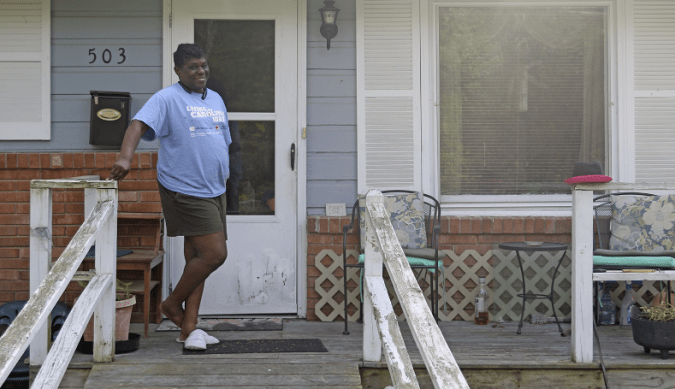
Meet Cleo Caldwell. If you’ve ever walked by her house you probably already have.

A fifty-something new grandma, she grew up on 503 Chapel Street in Chapel Hill’s Northside neighborhood, moved away, and came back to a different sort of place. When she was growing up, white people did not live on her street or on any of the surrounding blocks; Jim Crow determined where you lived and where you didn’t.

Now her neighbors are mostly students. And in her warm and exhuberant way, she embraces the change. She told a reporter from the Daily Tarheel recently:

Whenever they move in, I always introduce myself because this is my home, I grew up here and I know the whole neighborhood. (4/13/2017)

She says that with pride and generosity. Her neighborhood is open to all, though she is very clear about her expectations of neighborliness. As a teacher, I know that it’s essential to raise expectations for all students. Miss Cleo, as most people call her, raises expectations for all neighbors. It’s a formula for continuity and responsibility. In the name of community values like those that the Northside neighborhood was known for when she was coming up, she sets and publicizes the ground rules. She carries with her the institutional memory and the spirit of the place she grew up in.

In more recent times, she’s had to tell drug buyers and sellers down the street that they should take their business elsewhere. And since she remembers some of them from her childhood, she tells them, why don’t they just take it to their mamas and grandma’s street? Cleo reminds them that someone is always watching, someone who knows their mamas.

I felt instantly at home in Cleo’s living room. And so, I’m just going to give it to you straight the way Cleo gave it to me. Notice the italics I’ve put for emphasis. I think it’s interesting to ponder Cleo’s definition of ownership. She isn’t talking legal or financial. She gets at what it means to take ownership of your life and to make a real connection to your place in the world and to the people around you:

Cleo (CC): What I see when I sit on my porch—I do like to drink my Moscato—I sit on the porch and the students–

Me (AW): Moscato. I’m writing that down! [laughs]

CC: And the students will pass by and I, you know, some of them will pass by and I’m like, “Excuse me, I’m Miss Caldwell. You can speak to me when you see me on the porch.” They’re like, “Miss Cleo!” I even had the– girl, I’ve got it in that cabinet right there. They gave me a wine glass.

AW: [Laughs] You’ve got a reputation.

CC: You see that grill out there?

AW: Yeah.

CC: I’ll fire it up anytime. They’ll be like, “Oh, Miss Cleo, that smells good.” I’ll be like, “Come on over here. If y’all want something to eat, y’all come on over.” That’s just me. But I always tell them, when I’m sitting on my porch, everything that I can see I own. [emphasis mine]

AW: Oh my god. Well, you know what? That’s the nicest thing though for a lot of kids because a lot of college kids have no connection to real life.

CC: And I tell them, “Take care of the house that you live in, because somebody else used to live in that house.” [emphasis mine]

AW: That’s a beautiful thing. You’re a one-woman gospel.

CC: And I tell them, “You know, it’s okay for y’all to have y’all parties. I was once in college. It’s okay to have your parties. But guess what? Clean that yard up when y’all get finished.”

AW: Oh, yeah.

CC: I don’t have any problems. Especially like here.

AW: Do you ever have to talk to them?

CC: Uh-uh.

AW: You serious?

CC: Nope. None.

AW: That’s amazing.

CC: They go, “Miss Cleo, Can we park in your driveway, da, da, da.?” “Yup.”

AW: You never had any problems with any students?

CC: Uh-uh.

AW: Oh, that’s really—That’s amazing to hear.

CC: Nope. Because, like I said, I put my foot down on day one. What happens is the guys who live over there, they’re like, “Oh, yeah— “ I went over to introduce myself. “Oh, yeah, we know about you, Miss Cleo.”

AW: [laughs]

CC: So, they’re passing my name down. And I tell them, “When y’all go out of town, I have their cell numbers. If somebody’s going to be there, let me know, if everybody’s going to be gone. Because if something’s not right, I’m calling 911. I had to call 911 for that tan house. I’m sitting here—me and my friend are sitting here, and I’m like, Wait a minute. It’s Christmas. Everybody’s gone. So I sat and I watched them. I’m looking out the window and I just said –[makes a tapping gesture as though she’s pressing buttons on a phone]. I said, “This is Cleo Caldwell at 503 Chapel Street. There’s a guy over there in that yard over there on McDade. He don’t live there. The students are gone.” They came. And I even went out on the porch because I’m like, you know, a lot of people would be afraid because they might think the guy might retaliate or something. They had been looking for that guy, that same guy–

AW: Are you serious?

CC: had been breaking into houses. They had been looking for him. But they could not hold him because they did not catch him in the house. He didn’t break in. But he was looking for a way in. He would have went through and ransacked, took everything from those students.

AW: And you told those kids?

CC: And you know what I tell them, “We work too hard for the stuff that we have for them to come in and take it just like that.”

AW: Yeah, yeah.

CC: So I’m always watching. I’m like the neighborhood watch. If I hear sirens, if I see lights, I’m going to where that’s at. I want to know what’s going on.

AW: Yeah.

CC: Cause this is my neighborhood. [emphasis mine]

AW: I love to hear that.

CC: I own this neighborhood. [laughs]

AW: Oh, you do. And I love the way, I love what you’re doing with the kids because, you know, it makes them —even though they would not take the initiative usually—it makes them feel connected. You’re doing them a favor.

CC: Absolutely. And they know, in a couple years everybody’s going to be gone. But so-and-so and so-and-so is going to be there. Okay, because one guy came back early and I saw a light on. So before I called the police, I called the cell phone to make sure, “Hey, okay, I see a light on. Did somebody come—?“ “Oh, yeah, Miss Cleo. We’re sorry. So-and-so, so he came back early.” I said, “Okay, because I was getting ready to call the police.” I was on top of it. Oh, yes, ma’am. I watch.

AW: It’s not always like that. In some neighborhoods, there are kids doing things they shouldn’t do. There are disrespectful kids. They’re loud. They’re peeing on people’s lawns.

CC: Not in my neighborhood.

CC: Like I tell them, you know, I try to be involved. I try to preserve.[emphasis mine] … Habitat [for Humanity] was really, really good because I got into that program and everything. 

AW: You deserve everything that this neighborhood has to offer you.

        CC: I’m just trying to keep what I can.


The next day, I stopped by with a bottle of Moscato.

Her front door was open.


Pauli’s Legacy

UNC’s liberalism would soon be put to the test.  (www.paulimurrayproject.org)


In 1938, President Franklin Delano Roosevelt visited Chapel Hill, North Carolina, as he had done on a number of prior occasions, to accept an honorary degree. When he accepted the award, he called the University of North Carolina “a great institution of learning that was thinking and acting in terms of today and tomorrow and not merely in the tradition of yesterday,” and declared:

I am happy and proud to become an alumnus of the University of North Carolina, typifying as it does American liberal thought through American action.

But what FDR did not say was that this “liberal” university, like all Southern universities, did not admit African-American students even if they met the other admission criteria. When African-Americans wanted to attend college in the South, their only option was to matriculate at a “Negro” college, today referred to as HBCs (Historically Black Colleges).

If a Black student sought to study medicine or law or another subject not offered at “Negro” colleges in North Carolina, the state met its legal obligation to provide all children with access to education by giving them the option to attend a university “up North,” in this way upholding the strict separation of Black and White under Jim Crow.

Not all North Carolinians accepted this arrangement. In fact, just a few months before FDR received his honorary degree in Chapel Hill, a young, Black woman from Durham challenged UNC’s racist order by applying for admission to the law school. Emboldened by a keen intellect and a proud family tradition in education, Pauli Murray pursued the matter by going straight to the top.

A remarkable new book entitled, The Firebrand and First Lady describes the relationship between Murray and Eleanor Roosevelt that began when Pauli wrote to her husband, the President, furious that he had not taken a firm stand against lynching and white supremacy. She wrote:

It is the task of enlightened individuals to bring the torch of education to those who are not enlightened. There is a crying need for education among my own people. No on realizes this more than I do. But the un-Christian, un-American conditions in the South make it impossible for me and other young Negroes to live there and continue our faith in the ideals of democracy and Christianity.(as cited in Bell Scott, 27)

Then, alluding to the looming crisis beginning to consume FDR’s political agenda, she added: “We are as much political refugees from the South as any of the Jews in Germany.”

Finally, she challenged him by quoting directly from his acceptance speak at UNC:

You called on Americans to support a liberal philosophy based on democracy. What does this mean for Negro Americans? … Does it mean, that as an alumnus of the University of North Carolina, you are ready to use your prestige and influence to see to it that this step is taken toward greater opportunity for mutual understanding of race relations in the South? (as cited in Bell Scott, 28)

Murray included a letter for Mrs. Roosevelt, making reference to a brief encounter between the two women a few years earlier, imploring her to “try to understand the spirit and deep perplexity in which it is written.”

With this letter, the friendship between Murray and Eleanor Roosevelt began; it  intensified through correspondence and meetings over many years until Roosevelt’s death in 1962.

Murray was never accepted at UNC, despite personal petitions to President Frank Porter Graham, a personal friend of the Roosevelt’s, who seemed to sympathize with her pleas but felt it would not be politically expedient to honor them.

gwendolyn harrison smith

Gwendolyn Harrison Smith- first black woman to be admitted to a graduate program in 1951. The university first admitted her as it did other women on a case-by-case basis, not realizing she was African-American, then attempted to revoke her admission when their error was discovered. Harrison Smith, who had earned a BA at Spelman College and the and a master’s degree at the University of California, fought UNC’s policy and won, but left before finishing her degree. (Source: blackmattersus.com)

Murray went “up North,” graduating at the top of her class at Howard Law School. There, she met a man who became instrumental in desegregating UNC and later became the first Black Supreme Court Justice, Thurgood Marshall. Murray wanted to continue her education and applied for a fellowship at Harvard Law School. Interestingly, Murray was rejected by Harvard despite impeccable credentials, not because she was Black but because she was a woman. Murray spent her life fighting on both fronts.

frasiers and brandon

Ralph Frasier, John Brandon and LeRoy Frasier, Jr., on the UNC campus in 1955 (Source: unc.edu)

It wasn’t until the landmark 1954 Supreme Court Brown v. Board of Education decision that legal challenges to racist admission policies met with success. After a series of law suits, UNC was forced to accept black undergraduates for the first time in 1955. Three graduates of Hillside High in Durham– John Brandon, Ralph Frasier and LeRoy Frasier, Jr.– started together amidst vocal opposition by the Board of Trustees, as well as many administrators, faculty members and students. This antagonism was one of the main reasons all three of UNC’s first black undergrads left Carolina and graduated from other universities.

Pauli’s legacy, as well as Gwendolyn’s, Ralph’s, John’s and LeRoy’s and those of so many other pioneers, lies in questioning what liberalism has meant for the cause of racial and social justice. Though we often assume, wrongly, that the two are connected, they aren’t, neither in theory nor in practice.

In theory, liberalism offers freedom from restrictions and limitations, legal or otherwise. Liberalism is much closer to what we know as libertarianism, rather than social progressivism. Progressives rely on government and other mechanisms of power to level the playing field, to equalize opportunity, even if this means coercing resisters. Historically, liberals often have defended the idea of equal opportunity and fair competition, including equal access to education.

And yet it seems that in our university town, many liberals seem more concerned with securing resources for their children than creating a level playing field. I wonder if this is the case in other college towns that pride themselves on their good public schools. Among white educated families in Chapel Hill, the unlevel playing field is tolerated or ignored in the face of blatant inequality.

For centuries, liberal elites tolerated racial and gender-based barriers that denied education to a majority of US citizens. Despite demands made by social movements and activists, those with power to change things have accepted exorbitant higher education costs, even though these clearly limit access to the country’s best universities to all but a very small upper-middle class and wealthy minority.

Here in the state of North Carolina, tuition for state universities are often too costly and application requirements too complicated for many potential first-gen applicants. Even the community college system charges more than many kids can afford. And those who get in, often don’t make it through. Is enough being done?

If Chapel Hill is any indication, liberals do no better at creating conditions for educational success of African-Americans than elites in other towns do; in fact, the opportunity gap in town hasn’t changed much since segregation ended. And local elites aren’t really fooling anyone.

Screen Shot 2018-02-20 at 12.21.38 PM

Source: Raleigh News and Observer (October 30, 2015)

Pauli knew it; and she called UNC on it. Today her voice would most likely join the chorus of those teachers and parents who still regularly challenge town elites. Like Pauli and Gwendolyn and Ralph and John and LeRoy, local activists today speak their truths, then work with anyone who is willing to meet with them. So many local activists have simply not given up despite disappointment after disappointment. I’ve met many of them and the story is pretty much always the same. As one local minister said to me yesterday, “Politics are heavy in this town.”

And somehow enough people have been audacious enough to keep pushing for change.


For more on Pauli Murray, click here.

Lee way

Screen Shot 2018-02-20 at 12.00.43 PM.pngMany locals will tell people proudly that Chapel Hill, North Carolina, was the first majority-white town in the South to elect a Black mayor. The year was 1969. Though many told him it was too soon after desegregation and the town wasn’t ready, Howard Lee launched a campaign anyway. He used a strategy much like the one Barack Obama used to win the Presidency a few decades later: grassroots community organizing of the most thorough sort.

Lee and his wife had moved to Chapel Hill in 1964; he got a master’s degree at UNC, and then began teaching at Duke and North Carolina Central. Their story tells a lot about the climate at the time. As he told WUNC interviewer Frank Stasio:

I had tried to buy a house in Chapel Hill and no realtor would sell me a house. We finally ended up buying a house by working with a white family, by tricking the realtor.

I have heard a lot of stories like this one, about black people with audacity and individual white people with audacity who helped chip away at segregation. There are the stories of the legendary Dean Smith who entered segregated eating establishments with his Black players and requested a table. And a couple I know who did the same with their Black friends. And the students who demonstrated, sat in front of segregated stores, and engaged in various acts of civil disobedience for which some were arrested.

And yet the fact remains:  in the mid-1960s, after businesses had officially desegregated, black university professors were denied housing outside of neighborhoods historically designated as “black.” The Lees and their two children received death threats, and the Klan burned a cross on their front lawn. Lee twice went to the city asking the Council to pass an open housing ordinance. City officials refused. Swim clubs, university facilities, golf clubs– all were still segregated in the mid-1960s. As Lee puts it:

There were some nasty, nasty events in Chapel Hill during the civil rights era.

Though this observation may come as a surprise to some given Chapel Hill’s reputation as a liberal haven in the racist South, the Lees probably expected the town wouldn’t live up to the hype. Howard grew up in Georgia, joined the Army and served in Korea where he “tasted freedom.” As he told Stasio:

When you taste freedom and then you lose it again, that’s a tough pill to swallow. So when I came back from Korea and settled in as a probation officer in Savannah, Georgia, I found myself right back in the oppressive, discriminatory environment where I was paid a hundred dollars less than my white counterparts in the juvenile justice system.

What defined Lee’s fight for equality was his commitment to not racialize the issue directly, but to work within the system, using his position to advocate and act on behalf of those the system cheated. Another part of the “Lee Way” was to recognize the various forms oppression can take; in his experience, poor and working class white kids in Savannah also suffered disadvantages. Speaking of Savannah, Lee recalled:

We lived next door to whites. We got along well. … But the difference was during that day was white families thought they were better than black families and didn’t accept that they were being treated just as poorly. Today it’s even worse.

Lee saw the parallels when he moved to Chapel Hill where he recognized the plight of most of the white kids in mostly working class, or as many saw it, “redneck” Carrboro.

And yet it was in the Black neighborhoods that city street paving, maintenance, sewer and water stopped.

When he decided to run for mayor, he found himself opposed by a progressive democrat. But Lee wanted to make sure desegregation progressed and put it at the top of his agenda. At the time, only one-fifth of one percent of public officials in the US was black.

Lee was, I think, enticed by the challenge and had a vision for how African-Americans and other disenfranchised groups could challenge systemic injustices and gain power within the system:

We organized Chapel Hill like it had never been organized before by using students from the university and faculty and also brining students in from around the state using somewhat of a civil rights tactic of getting people to come from the outside to help us on the inside.

For Lee, his campaign wasn’t about race. It was about fairness and empowerment. And it was about educating African-Americans about the power they could wield in a democracy when they were organized and informed. One of the local activists, Edwin Caldwell, whose family members had been at the forefront of the local civil rights movement, gives a moving and powerful account of the way the Lee campaign worked “on the ground” on election day:

We would say, ‘Look, who are you going to vote for?’ “Well you know I’m going to let the Lord.” I said, “No, we ain’t going to let the Lord choose today. You take this piece of paper, this is who you vote for. You let the lord choose some other day.” So we pretty much told them who to vote for. We controlled things. They went in there and they came out and people were proud. You talking about South Africa and voting, people were voting in Chapel Hill and they were proud the same way. You could just see their backs straighten up and see how proud they were. I worked the streets until the polls closed, we got every vote that we could find. We almost wrestled some people in that didn’t want to go, but once they went and voted they were proud.

So there is a strong commitment to democracy and justice in this liberal town. But it’s just not among those folks who most often take credit for it. Howard Lee’s election is more a story of what it took for Blacks to overcome the many obstacles to equality here than a story of white liberal progressivism.