Survival Camp for Kids

andreacwuerth's avatarFacultyMeeting

R-E-S-P-E-C-T.

Miss Rose carefully wrote the upper case letters on the whiteboard and underlined it so that the marker squeaked. Then she turned and scanned the room, briefly making eye contact with the twenty-or-so older elementary and middle school kids, all black or brown, sitting sheepishly but attentively at the half-dozen plastic tables.

Something must have gone wrong at the morning summer camp session to warrant this talking-to. Miss Rose was not messing around. The room was dead quiet. She began by letting them know that respect meant you should do what a grown-up asks you to do, and you should give them attention and respond quickly to their requests. The kids were asked about a number of behaviors that seemed to clearly refer to some of their earlier misdeeds:

  • If you put your head on the desk when a grown-up is talking, is that respectful?
  • If you run around…

View original post 674 more words

Education without representation

andreacwuerth's avatarFacultyMeeting

I was having tea with a teacher-friend, and we got to talking about teacher salaries in our district. The Republican governor and his Tea Party pals are often blamed by the many liberal voices in Chapel Hill for the decline in teacher pay. And yet if anyone had listened to teachers in Chapel Hill last year (and for the last few years) they would know that the district had a chance to do right by us and significantly raise the across-the-board supplement… and they didn’t.

We got raises (I should say, “They” since these raises did not apply to the many part-time teachers in the district) but not as much as teachers in the neighboring county did. Instead, our school district leaders opted to institute a program in which teachers compete against each other for raises which are only awarded to a small percentage of teachers each year. In a rare

View original post 616 more words

A Tale of Two Schools

andreacwuerth's avatarFacultyMeeting

The phrase “neighborhood schools” has become a synonym for resegregation, a nice-sounding buzzword for reactionary education politics; and that’s too bad. Because when neighborhoods are really caring places rather than fearful gated communities, they provide a support structure for kids and for teachers.

I was recently talking with some folks at the Marian Cheek Jackson Center, a research and outreach center in the Northside neighborhood of Chapel Hill. Their goal is to keep the historical memory of the neighborhood alive by recording oral histories. The Center’s staff and volunteers also are very committed to preserving the sense of neighborhood that existed before the onslaught of gentrification and goes back generations.

The Center has collected stories of local residents and seeks to share Northside’s rich history with students at local schools and at UNC who otherwise, most likely, would not learn about their local history and thus not make connections between…

View original post 706 more words

Same old pie, warmed over

andreacwuerth's avatarFacultyMeeting

Last week I saw the movie, The 13th. If somehow you don’t know how to make sense of the wave of police brutality against African-Americans or reports on the mass incarceration of Black men, this documentary is the one to see. lies

As a social studies teacher, I have become very aware of, as James Loewen put it, the “lies” history teachers tell.  And, by not always pointing out to my students that their history textbooks present a narrative of “our” history filled with skewed interpretations and omissions, I guess I’ve been lying too.

That said, it has become patently clear that the meta-narrative of American history found in our textbooks is a distortion of the historical record since it averts our gaze from the experiences of whole classes and groups of people and focuses instead on the actions of a few powerful people. The message that students usually hear is that…

View original post 1,204 more words

A Hollywood Ending

andreacwuerth's avatarFacultyMeeting

When Donny “Hollywood” Riggsbee tells his story about growing up in Chapel Hill in the years leading up to and following segregation and the civil rights movement, his story takes some unexpected twists.

Like when he remembers his interactions with white college students. He recalls when he was a housekeeper in one of the student dormitories fondly, chuckling as he describes how they would drink beer together on Friday nights.

Or like when he describes his reaction to the assassination of Martin Luther King, Jr., and someone warns him that there’ll be riots in Chapel Hill:

“That ain’t nothing to do with us.” I said. He said, “There’s gonna be a riot, there’s gonna be a riot.” I said, “Oh, man, please, come on now. We ain’t about all that,” I said. 

Or when he says that his most important mentor was Big John, the owner of Colonial Drug. The…

View original post 1,680 more words

The Power of a Story

andreacwuerth's avatarFacultyMeeting

For anyone who doubts the impact one person’s story can have, for anyone who thinks history is only about the past, I say, you should have been at Lakewood Middle in Durham yesterday.

The students had been learning about social movements and today were learning about the value of oral histories from our group from the Jackson Center in neighboring Chapel Hill, an organization dedicated to preserving the history of the historically-black Northside neighborhood whose residents had been at the center of the local civil rights protests and sit-ins.

After listening to a presentation about oral history and interviewing techniques, their assignment was to come up with questions to ask one of the four visitors we call “mentors.” I had the privilege of introducting one of those mentors, Miss Gwen. Miss Gwen, a retired teacher in the Chapel Hill schools, took a seat in front of twenty-five middle schoolers, who…

View original post 499 more words

The Power of a Story, Part II “Mama Kat”

andreacwuerth's avatarFacultyMeeting

The best way to sense the power of a story is to hear the reactions of those who have the privilege of hearing a really good one.

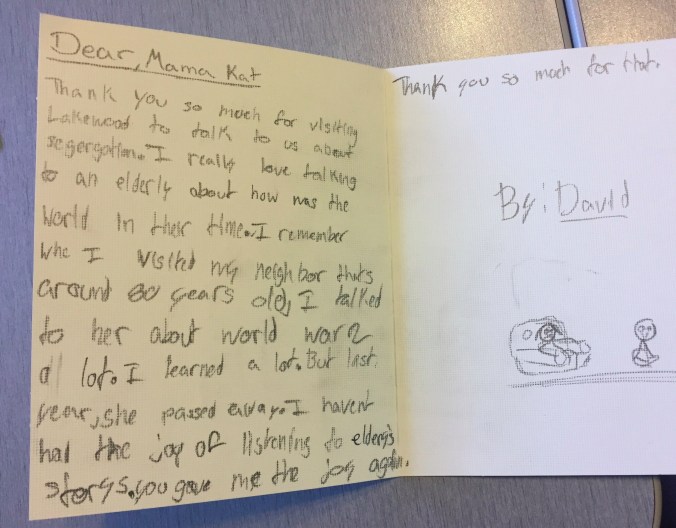
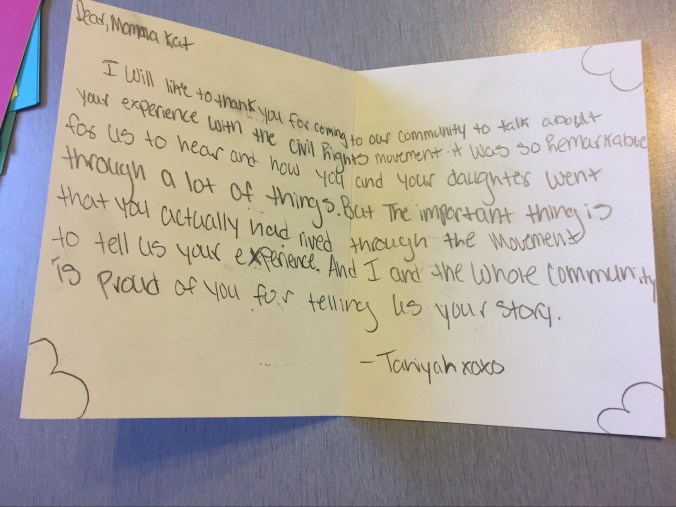
I had the chance to return to Lakewood Middle, this time with Northside resident, Katherine Council, better known as “Mama Kat.” She talked about her experiences in segregated Chapel Hill, as well as during and after the Civil Rights movement, including the story behind this picture of her daughter (on far right) and future son-in-law (far left).

photo 1 Reprinted in Jim Wallace, Courage in the Moment

.

Rather than summarize my impressions of my morning with Mama Kat, I will just let the kids do that, each in his or her own way:

Mama Kat 1Mama Kat 2Mama Kat 3Mama Kat 6Mama Kat 5Mama Kat 4

View original post

The kid at the door

andreacwuerth's avatarFacultyMeeting

When I was in education school, we had to observe teachers in the classroom and write up our observations, like educational anthropologists. I observed a teacher who later became a colleague, a very well-respected veteran teacher. He knew what he was doing– he was enthusiastic about his subject, related warmly to students, engaged students. My notes from eight years ago read:

He is very skillful in making kids feel at ease; relates to students in personal and humorous ways. Also tries to draw out more reticent and ‘nerdy’ kids. Told me he thinks each student is gifted in some way and this seems genuine.

This was an AP history class in one of the highest scoring schools in the state, and I began wondering about equity in a competitive school culture where the playing field is not level. I saw very few kids of color in these classes. And so…

View original post 999 more words

Nasty people needed

andreacwuerth's avatarFacultyMeeting

Recently I attended a groundbreaking ceremony for a new sewage system in the Rogers Road neighborhood of Chapel Hill. This moment was the culmination of decades of struggle and setback that began in 1972 when the neighborhood was promised a number of infrastructural equalizers. Rogers Road seemed to have been overlooked when the towns of Chapel Hill and Carrboro, as well as Orange County claimed and serviced neighborhoods all around this one.

City council members and county commissioners were present at the ceremony, smiling for the cameras as they awkwardly inserted their gold-painted spades into the clay.

Those who led the struggle were acknowledged and held brief speeches thanking other members of the community who supported them. But they stood on the fringes as the groundbreaking proceeded. When I offered one of these men a congratulatory handshake, he said quietly, “I feel uncomfortable at these things.” He may have meant…

View original post 1,091 more words

Aha Moments

andreacwuerth's avatarFacultyMeeting

It was the end of our second interview, and I wanted to ask David Caldwell, Jr., something that would help me summarize the life stories of this remarkable man.

I glanced at my question sheet and asked: “When you look back at your childhood and everything, what do you think was the critical point where you really had your “Aha moment,” saying, “Okay, now I know what I want to do with my life”?

After, graciously, trying to answer the question, David took it down a different path altogether.

DC:  I don’t think I’ve had–. It’s like a cake. Eggs don’t make the cake. The batter doesn’t make the cake. Water, the margarine, the baking powder, it doesn’t –. You have to put it all together. And as you start putting those ingredients together, it’s “Oh, this is a cake! Let’s put some icing on it.” So then you…

View original post 872 more words