“This is how I heard the story. . . .” Michael Chabon, Moonglow
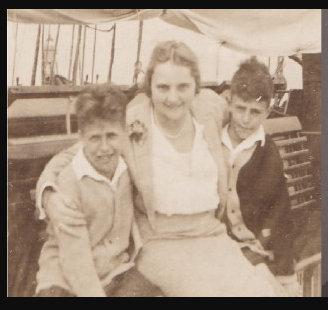
Luke, on right, with his mother and twin brother, Hans, in the early 1930s in Holland
Louis “Luke” Wijnberg, is a resident of a neighborhood in Chapel Hill, North Carolina, that today is known as “Northside.” In close proximity to the university that employed most of its residents, Northside was an all-black neighborhood before desegregation. Over the last fifty years, the neighborhood has seen an influx of new residents and has become more diverse and less affordable. As a volunteer for the Jackson Center for Saving and Making History, I conduct interviews, recording life stories of past and current residents like Luke, who bought his house in 2007.
Luke recently turned 95, so he’s older (but not much older) than some of the other residents I’ve talked with. But unlike the others, he is white.
Before he even agreed to sit down with me, Luke questioned the premise for the interview, suggesting that his reasons for living in the neighborhood had nothing to do with its history. In fact, he didn’t know much about the history of the neighborhood at all and had had little interaction with his neighbors since moving there. As he put it: “I am just one relatively ordinary person who happened to choose 611 Sykes Street as his domicile.”
I persisted, since the director of the Center had passed Luke’s name on to me, mentioning that he knew Luke had a unique and interesting story to tell. For starters, he was a Holocaust survivor.
“Well,” I said. “I want to learn a bit more about your history. You are a Holocaust survivor. Is that right?”
“No. I’m not a survivor. I was never in the camps,” he responded.
The US Holocaust Memorial Museum’s official definition of a survivor includes anyone who was displaced by the policies of the Nazis or their Allies, including refugees like Luke. (www.ushmm.org) Born in Holland, his Jewish parents made arrangements for then sixteen-year-old Luke and his twin brother Hans to emigrate to the United States in 1939. They were adopted by a couple in Brooklyn and heard only after the war ended that their parents, younger brother and many of their close relatives had been rounded up by the Nazis after they occupied Holland, deported to the Westerbork detention camp, and eventually murdered in Auschwitz.
Luke and I continued our introductory conversation for more than an hour. He gave me an overview of some of the major turning points in his life– childhood in Holland, emigration to Brooklyn, matriculation at Brooklyn Polytechnic; enlistment in US Army and return to the European continent as a soldier in WWII; graduate school in engineering physics at Cornell and SUNY; marriage; first jobs in NY state; kids; divorce; second marriage; move to Chapel Hill. By the end of that first meeting, he still was not ready to commit to an interview. He said he’d let me know.
The message I received a few days later was a cc-ed copy of an email addressed to his daughter, Debbie:
I live in the Northside community section of Chapel Hill – traditionally the … enclave for African Americans. UNC has provided some money to establish a kind 0f archive of the residents, old and new, of the Northside neighborhood. One of those residents is me, and Andrea picked on me because I am 94, because I am an immigrant from Europe, because I managed to avoid getting axed in the holocaust (being Jewish), etc. ,because I chose to settle down in late life in the Northside neighborhood. (it was financially doable!) I have not committed myself to provide an interview but am tempted in part in response to Andrea’s obvious interest and dedication.
The next day he confirmed: “I want to go ahead with the interview.”
When I asked him why he conceded, his response was, “If not now, when?” I was, for once, in the right place at the right time.
We began the following Friday– July 25, 2017– and have been meeting more or less weekly ever since. A few times now he’s said in his typical deadpan manner, “We’re going to be doing this until I kick the bucket.”
I am now trying to piece together themes from the stories he’s told me and to begin to reach some understanding of who he is, of the specific circumstances that shaped his life and, in turn, his reactions to and efforts to make sense of those circumstances. My rendering of his life and my understanding of it is incomplete and personal. It is presented here bit by bit, insight by insight. Writing about a life– someone else’s or one’s own– is a process fraught with choices. The writer has someone else’s life in her hands; a series of decisions, some deliberate, some not, transform one person’s stories about their life into the writer’s creation. The stories told are based on what is remembered, fragments, that first the teller, then the writer, piece together into a narrative.
When a life spans more than nine decades as Luke’s does, writing about it feels risky at every turn. Events are recalled that happened long ago. Memory fades though why some are lost and some remain is not clear. And so narratives are incomplete, perhaps random.
Someone who tells the stories is telling how they remember things, and someone who retells the stories is telling not what they heard so much as how they heard them. The fiction that results is what we call “biography” or “autobiography.” And for someone who has been trained to write works that appear on the non-fiction shelves, writing fiction is new terrain.
In the telling of his story, Luke reveals elements that trouble him, raises questions that he cannot answer. It’s as though he is searching for some truth in the telling. — open, reflective, introspective, self-critical. His stories are riveting not only because they contain glimpses into some of the most important developments of the last century, but also because the listener is invited to explores the thoughts and emotions his most vivid memories conjure up. His reflections are lucid and sharp, intellectually rendered but emotionally charged, at times, eccentric, disturbing and humorous. His use of language is very precise and yet appears spontaneous, as though he is thinking out loud; he is a gifted storyteller, who engages the listener not with embellishment and melodrama but straightforward detailed accounts that appear uncensored.
He reflects on his memories as he relates them, engaging the listener’s imagination by his frequent use of phrases like, “I don’t know why I did that,” or “I have no idea why I remember that.” When he then ponders aloud possible explanations, he often brings Freud into the conversation, wondering which subconscious forces might have caused him to focus his attention on certain moments in his life.
What makes talking with Luke such an interactive experience is that he seems to have offered me an open invitation to posit my own spontaneous interpretations, and he takes the time to ponder and react to them. Sometimes he turns the focus on me, asking me to explain my interpretation in greater depth.
The result has been much more than a series of interviews but a relationship between the interviewee–Luke– and the interviewer–me, a friendship that is both intellectual and personal.
 Chapel Hill Stories
Are the interviews public?
LikeLike